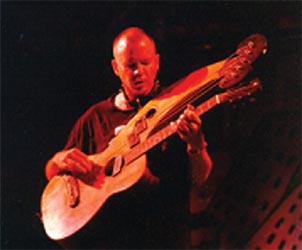
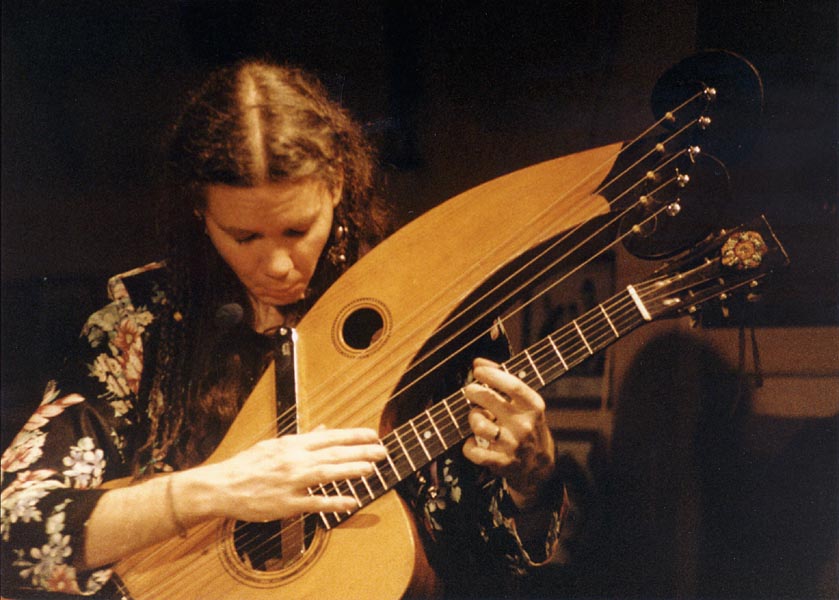
Michael HedgesBy Nate Blaustein,
February, 2006 Updated October, 2008 by Frank Doucette and editor Gregg Miner |
|
|
|
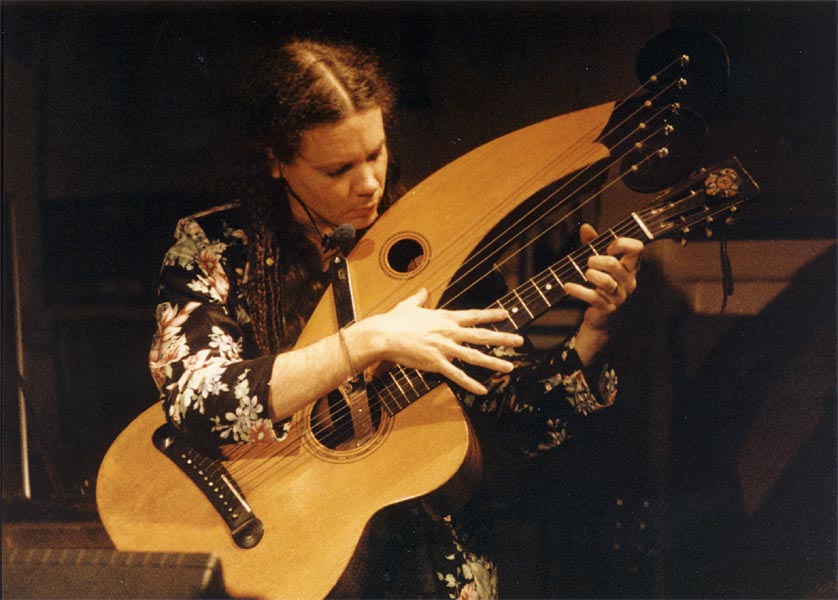
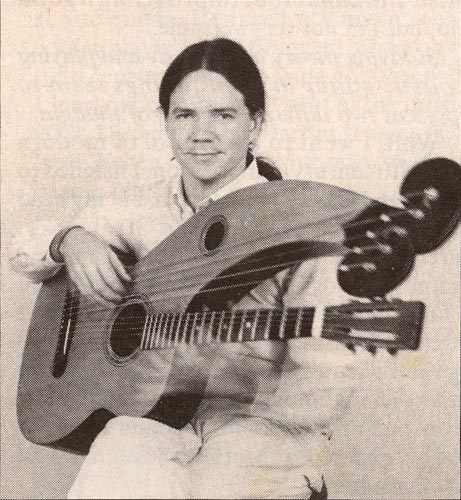
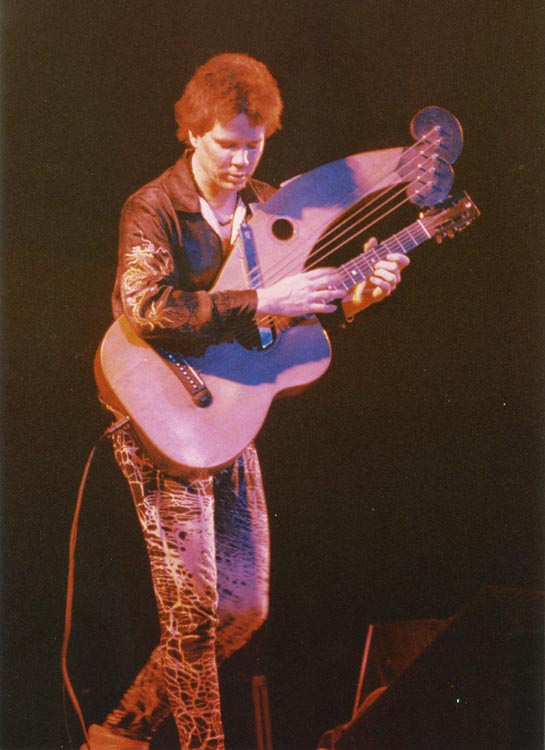
On April 10, 1994, I sat in a Chicago performance hall transfixed as my soon-to-be musical idol lifted an unwieldy, misshaped instrument that vaguely resembled a guitar from its case. The next three minutes and thirteen seconds brought me to my knees (almost literally) as I heard “Because It’s There” for the first time. Many have cited Michael Hedges as one of the most pivotal composers in the history of the harp guitar. Over his years of performing, he influenced countless musicians by recognizing the possibilities beyond six strings. His untimely death in 1997 left a void that will not be easily filled. |
|
Hedges was born in Sacramento, California in 1953, later moving to Oklahoma. He was surrounded by music as a child and at an early age showed talent and proficiency. He began playing the guitar in the 6th grade and formed a rock band by the 8th grade. He attended Phillips University, then Peabody Conservatory in Baltimore studying composition and classical guitar. During the summer he spent time at Interlochen furthering his education. The nights were spent in bars honing his technique and covering tunes by Joni Mitchell and Neil Young. After signing a contract on a napkin with Will Ackerman for Windham Hill in a crowded bar attic, he went on to redefine the acoustic guitar on albums such as “Breakfast in the Field” and “Aerial Boundaries.” Hedges’ compositions required the 6-string acoustic to function as it never had before. Unique tunings and techniques were developed that have since been adopted by many contemporary players. |
|
“Composers
filter their input - modifying, distilling or leaving raw what
shouldn’t be touched. |
| Many quickly fell under Hedges’ spell. Classical and jazz musicians quickly took note of his complex compositional abilities while the rockers appreciated his sense of rhythm and driving melodies. During interviews, he discussed Bela Bartok and Whitesnake in the same breath. He quoted Galileo and Neneh Cherry with equal enthusiasm. Yet with Hedges there was a recurring theme of being primarily a composer, not a guitarist. |
|
“I
think my music comes as the result of being unable to classify
something. |
|
It was likely that thirst for something that could express his music that led to the harp guitar. It is unclear exactly when he acquired his first harp guitar, a Dyer, but we do know that he was developing music for this instrument by early 1985. “I saw it in a music store and I knew it was for me, so I
just got it…. Guitar Player, Feb 1985 “I’m also spending about a third of my time on harp guitar. I got a Dyer made in the ‘20s or earlier by Maurer in Chicago (actually the Larson brothers - GM). Mine has five harp strings, but there’s room for six. Right now, the harp strings are tuned G Bb D C A and D, low to high. (the extra D must have been an editor’s error - GM) I’m working out bass lines to do with the right hand on the harp strings while I’m tapping with the left hand on the guitar strings.” |
|
|
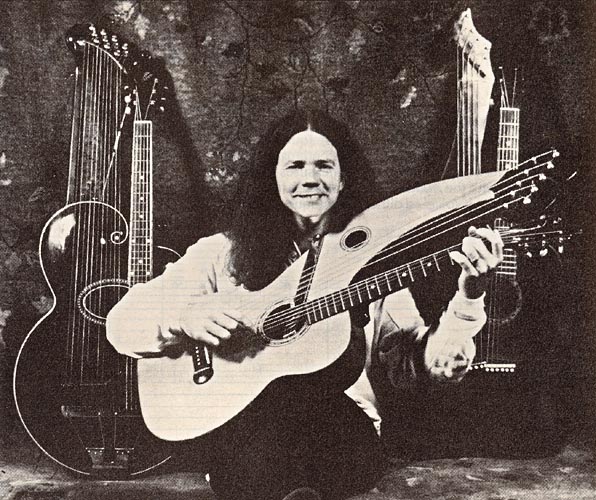
Frets, Nov 1986 “At the age of 32, Hedges has just begun to explore his latest artistic passion, the harp guitar. He owns two 11-string Dyers (six regular guitar strings on a standard fretboard, and five bass harp strings), and has recently acquired a 17-string Gibson, with 11 chromatically-tuned bass harp strings.” (Editor’s note: Hedges’ first Dyer, a Style 4, was a 6 sub-bass model with the last string hole plugged. The second “11-string Dyer mentioned was in actuality his black Knutsen – as seen in the accompanying photo with erroneous caption. He did acquire another 6-bass Dyer eventually. The 11 sub-bass Gibson model could have been a rare factory custom order (it was sometimes mentioned as an "option") or a modified 10-bass Style U. The bridge/tailpiece does not quite match any know models from any era. – GM) “And I love the sound of open strings, which explains why I have really gotten into harp guitar recently. I like the sound of the long strings. I have this tune I play on my Dyer guitar with G Bb C A D as the bass line. I tuned them in this order because that way I could mute them with my right hand, using rest strokes. Once I got familiar with that tuning, I started writing another tune, and for that one I changed maybe one string.” “I’m really excited about all the possibilities of the harp guitar. I’m as excited about it as I was about the 6-string when I first started. The extra voices, and the possibilities of hammer-ons and pull-offs with the left hand, and picking other notes with the right hand, make me excited about playing guitar. I already have two new songs and two new instrumentals written for harp guitar, which I’ll be performing soon – almost half a set's worth.” |
|
|
|
In 1986, Hedges participated in two groundbreaking albums that reintroduced the harp guitar to the masses. The first was titled “The Shape of the Land” and was the soundtrack to the biography of the Japanese explorer Naomi Uemura. The album features the two harp guitar compositions “Aurora / Nevermore” and “Because It’s There” (BIT). BIT became a staple in his performances and was played throughout his career, creating in its wake many followers asking, “Where can I get one of those guitars?” Structurally similar to the earlier composition “Aerial Boundaries,” BIT employs the Dyer’s five sub-bass strings to present the melody, with the six strings providing rhythm and accompaniment with hammer-ons and pull-offs. This differs dramatically from previous harp guitar compositions that use the sub-basses to support lead lines on the six string. This piece has been notated and analyzed by John Stropes and is available at his website for purchase (www.stropes.com). |
 Frets Magazine, November, 1986 |
|
The same year saw the release of “Santabear’s First Christmas,” with Kelly McGillis narrating and Hedges performing the soundtrack (a part originally intended for Stanley Jordan). From it came the two harp guitar songs: “Carol Jean” and “The Double Planet.” “The Double Planet” and BIT became highlights during his live performances and they were re-released in 1987 on a live album entitled “Live on the Double Planet.” Associated promotions included a Windham Hill video release featuring BIT and tour shirts with pictures of Hedges holding his Dyer. Word quickly spread and crowds grew larger. In 1988, Hedges was included in a Windham Hill compilation disc entitled Winter Solstice II in which he performs Bach’s “Cello Suite #1 in G major” on the harp guitar. For Windham Hill’s Winter Solstice III, released in 1990, he used the Dyer to play individual lines in a multi-layered arrangement of Bach’s “In Dulci Jubilo.” This track later appeared on a 1996 release called “Guitars (and Other Stringed Things): A Windham Hill Christmas Collection.” |
|||
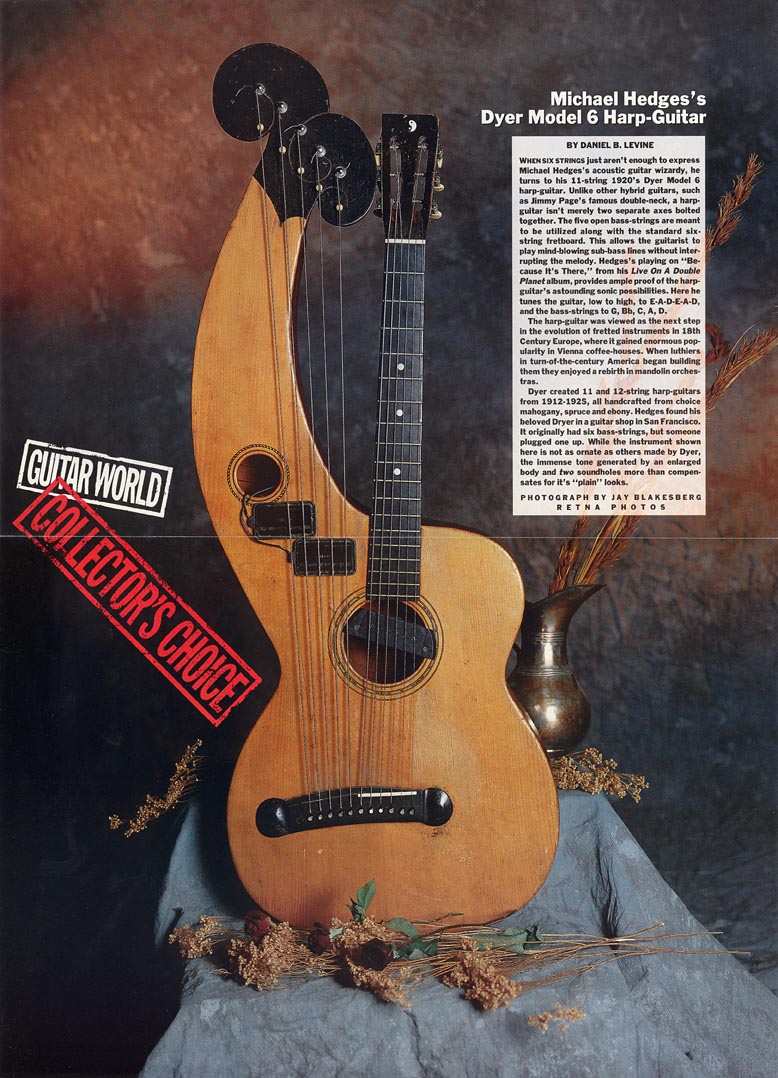
 from Guitar World, May, 1988 |
Editor's Note (at right): Guitar World magazine included a "centerfold" of Hedges' Dyer. I have no idea where they got the "Dyer Style 6" as it is clearly a Style 4 (basic model). As it turns out, it is actually a six sub-bass Dyer - the tuner and bridge holes for the last string were plugged, apparently before Hedges obtained it. Who knows what Because It's There might have sounded like had he fully restored it! - GM |
 |
|
| In his interview in the same 1988 Guitar World magazine, Hedges talks more about his harp guitars. He is still calling the Knutsen a Dyer, and it is also apparent that he is still struggling with the original friction 1:1 sub-bass tuners on his Dyer (at the time, one simply didn't replace functional original hardware). Most interestingly, he says "I just met the older Dyer guy, not the guy who built the guitars but their grandson, and he has agreed to sell me the one that is in a little bit better shape than mine.” | |
|
Hedges was referring, of course, to
Robert Carl
Hartman, Larson brothers expert and author of four books on the subject.
When asked about this encounter, Bob supplied this wonderful photo
(taken by his wife Carol) and had this to say:
"I met Michael in Madison, Wisconsin in the summer of 1987 and showed him the four harps I had. He was there for a week-long master class along with top players from around the world; the program was the brilliant idea of John Stropes. Each teacher had classes and had a concert one evening. I think Michael was on that night with John Renbourn. Michael tuned each of my four harp guitars in a different tuning and played a song on each for Carol , my son, two friends and I. I must have mentioned selling him a harp guitar but it never came about." (Hedges ultimately did get a second, six sub-bass Dyer - GM) |
|
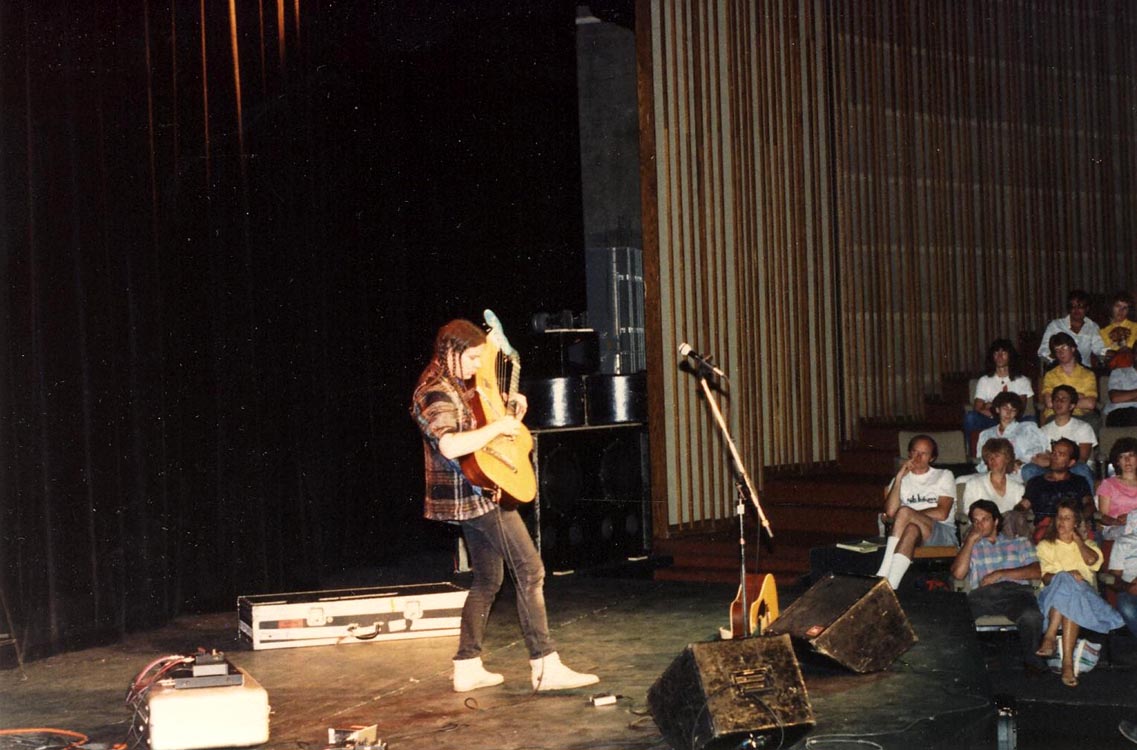 |
Bob got in trouble (as well he should have!) for taking this flash photo from his balcony seat. No, that's not Muriel Anderson sleeping in the first row...she was actually sitting next to Bob (the occasion of their first introduction). - GM |
|
|
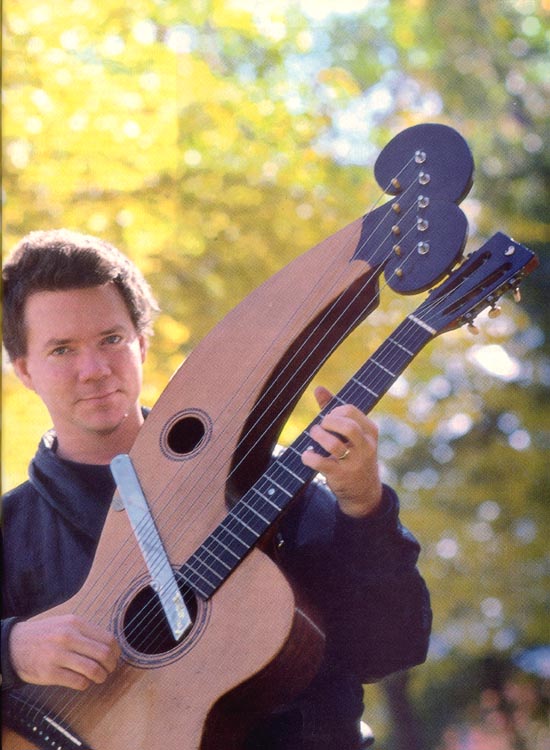
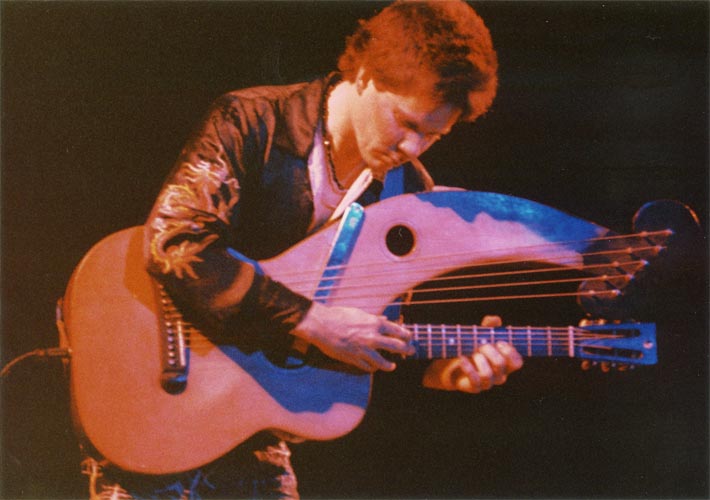
Hedges called Leo Kottke his first and only fingerpicking guitar idol. The two had their first gig together in 1985 and became close friends. Management took advantage of this in 1988, thinking that it would be easier to get people out to see two guitarists rather than just one. Hedges and Kottke talked about recording together but, sadly, never got around to it. They had about six duo arrangements worked out, including one or two with Hedges on harp guitar. Concert at at John M. Green Hall at Smith College in Northampton, MA 3 images copyright Robert Miller, courtesy Frank Doucette |
|
|
|
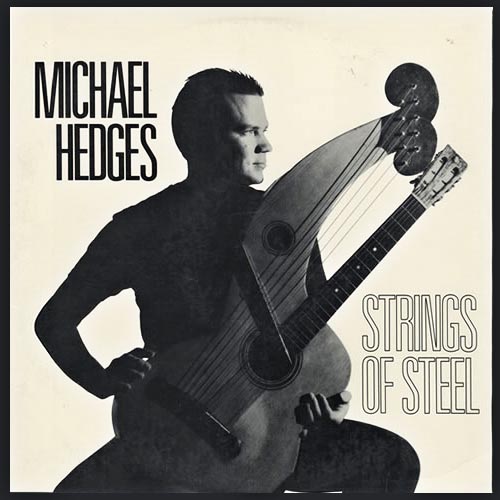
The "Strings Of Steel" LP was part of an ultra-rare 1988 press kit for the U.S. tour with Leo Kottke. - GM
|
|
|
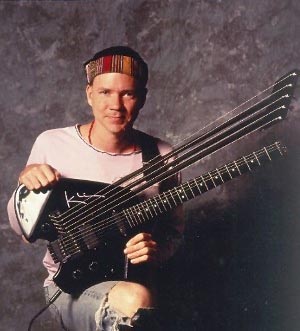
The “Taproot” album (1990) marked a high point in Hedges’ career. It was released at the peak of the New Age movement and the pinnacle of Windham Hill’s success. Although there were now many fingerstyle guitarists, Hedges was one of exceedingly few using the harp guitar regularly, and none more visibly. For this album, “Chava’s song” was recorded as a duet with George Winston on piano, yet there has been recent speculation by Jeff Titus that it was initially composed for solo harp guitar (8-1-08: unfortunately, Michael Manring recently informed Jeff that this was definitely not the case. - GM). “Point A/Point B” was played on a new Steve Klein Transtrem Harp Guitar which Hedges then began taking on the road with him. |
 |
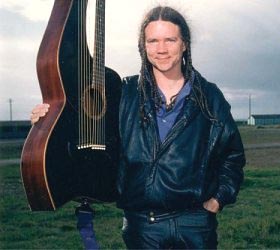
Throughout the ‘90s, Hedges continued to use the harp guitar during his performances. He electrified and stunned audiences with interpretations of “Comfortably Numb,” “No Expectations,” and “Almost cut my Hair.” He also composed his first vocal/harp guitar piece entitled “Torched” which addressed his recent divorce. In 1996, Hedges and his harp guitar appeared as guests on the album “Sticks and Stones” by Robert Eberhard Young. |
|
|
| 1996 also brought another multi-tracked arrangement featuring harp guitar. This version of “What Child is This?” was released on the Windham Hill compilation “Carols of Christmas” but Hedges also included it as an uncredited bonus track on the “Oracle” CD. He did this without Windham Hill’s approval or knowledge so that fans wouldn’t have to buy the Christmas release if they only wanted the one track. The track was released again on Windham Hill’s “Winter Solstice on Ice in 1999.” | |||
| By this point Hedges had several harp guitars in his arsenal. Perhaps as a result of this increased inventory, a review of magazine articles finds many inaccuracies in identification and description of his instruments. His Dyer was labeled as a Maurer harp guitar in one article while another called his Knutsen a Dyer. Regardless, he was using his trusty Dyer as well as the Klein Transtrem. He also owned a Gibson U with 11 sub-basses, and was using a Knutsen Seattle-style circa 1912 harp guitar named ‘Darth’ with increasing frequency. |
|
||
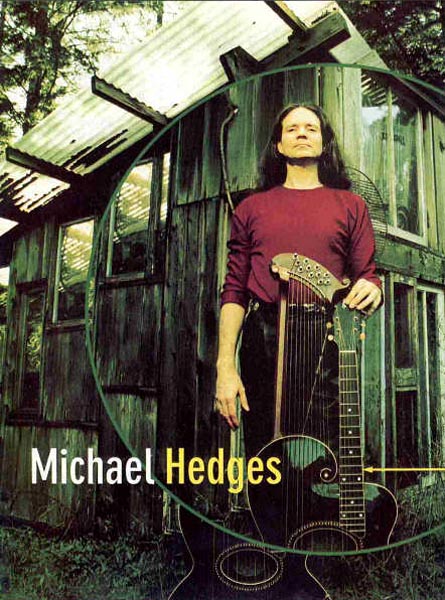 from Musician, November, 1995 |
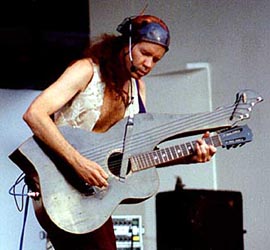
courtesy Alan Tignanelli |
||
|
Note: The
Gibson appears to be a standard 10-sub-bass Style U, but with an added 11th sub-bass.
This
could have been a custom Gibson
offering,
or a later retro-fit. |
|||
|
|
Throughout his career Hedges worked diligently on the best ways to capture his sound. For electronics he frequently used a combination of a FRAP under-the-saddle pickup with a Sunrise S-1 magnetic pickup in the soundhole. To represent the sub-basses he initially used an Autoharp Magnetic pickup (pictured above with the Knutsen), then a Barcus Berry magnetic pickup (pictured with the Dyer at left). | |
|
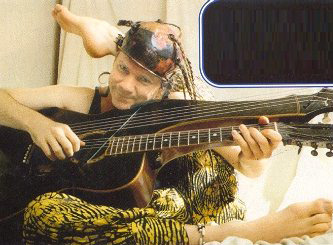
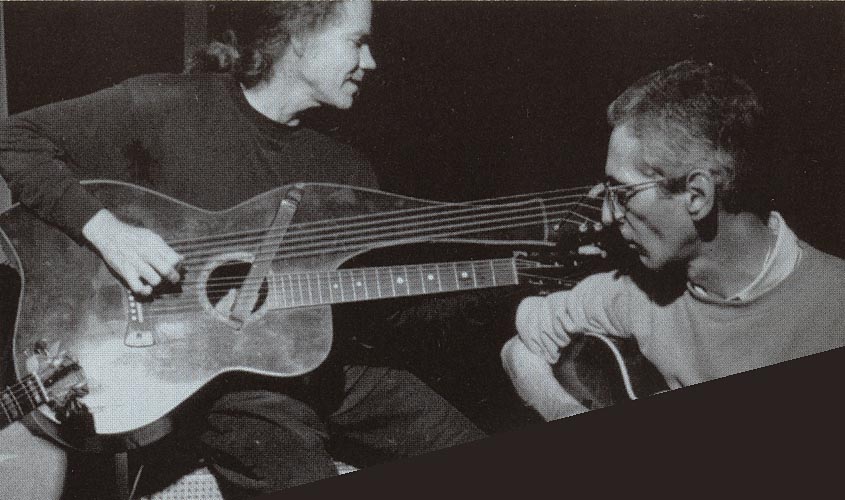
Pat Martino “All Sides Now” 1997 Despite the teaser of a liner notes photo showing Martino jamming with Hedges on his black Knutsen harp guitar, it does not appear to have been used on the recording. The credits list a “steel-string acoustic guitar” and no sub-basses are heard. |
 |
|
|
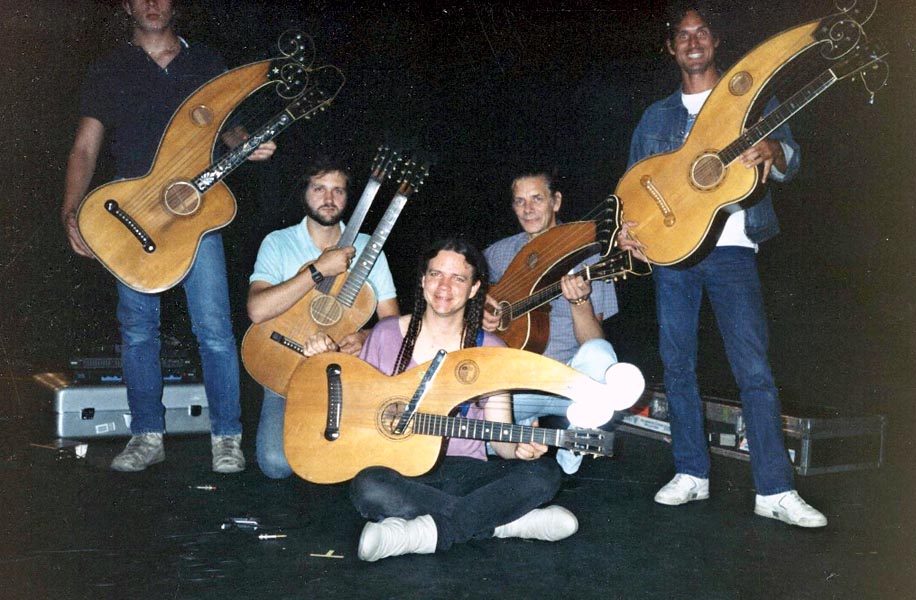
On December 1, 1997, Michael Hedges tragically died in a car accident. There is much speculation as to where his relationship with the harp guitar would have led in the years to come. However, there is no ambiguity as to the impact he had on the current revival beyond six strings. Postscript We will forever be indebted to Michael Hedges for the inspiration he has brought to untold guitarists, and as the instigation for so many of our growing "harp guitar brotherhood" to join the harp guitar movement. Many have stories of inspiration to tell. Guitarist Doug Geeting's should be particularly noteworthy to the fans of Hedges' most famous piece, "Because It's There." -GM
|
||
| If you enjoyed this page, or
found it useful for research, please consider supporting
Harpguitars.net so that this information will be available for
others like you and to future generations. Thanks!
|
|
All Site Contents Copyright © Gregg Miner, 2004,2005,2006. All Rights Reserved. Copyright and Fair Use of material and use of images: See Copyright and Fair Use policy. |
|
If you enjoyed this article, or found it
useful for research, please consider making a donation to The
Harp Guitar Foundation,
|
|
|
|
All Site Contents Copyright © Gregg Miner,2004-2020. All Rights Reserved. Copyright and Fair Use of material and use of images: See Copyright and Fair Use policy. |