|
Organology: Harp Guitar "Relatives" Note to the casual reader or researcher: This Reference Gallery features historical instruments that are not harp guitars, but “relatives” or distant “cousins” – presented on Harpguitars.net for historical and organological comparison.
Mixed Family Hybrids
& Other Related Forms Non-family specific instruments similar or related to harp guitars. While some researchers consider some of these instruments true "harp guitars," I found it more realistic to label them organologically as "hybrids" or "one-offs." See bottom of page for image copyright information |
French
 |
 |
 |
 |
 |
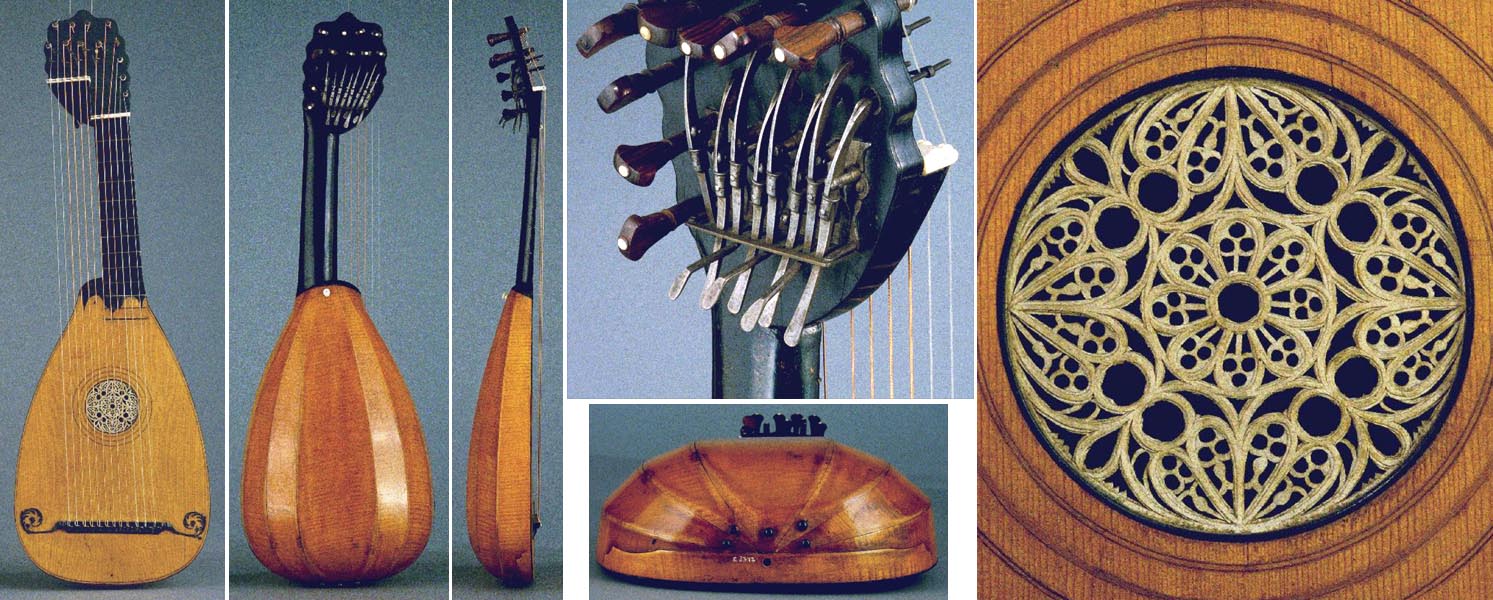
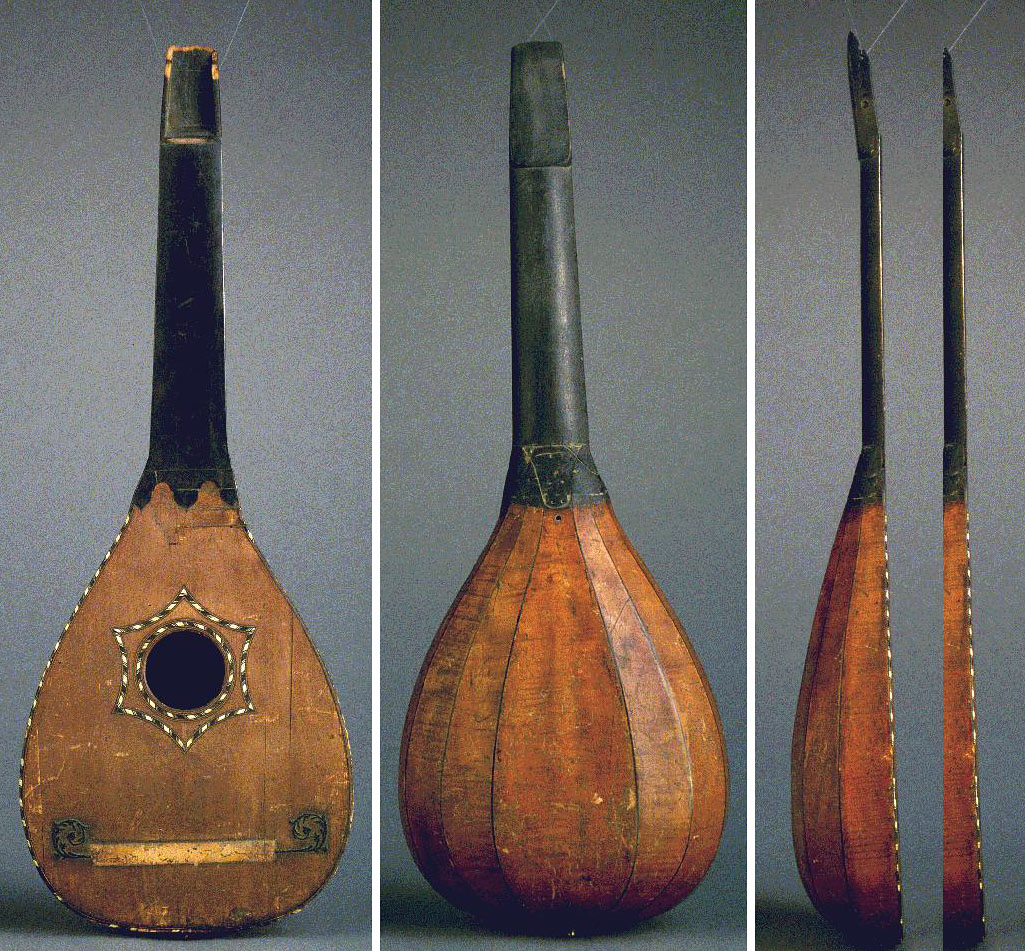
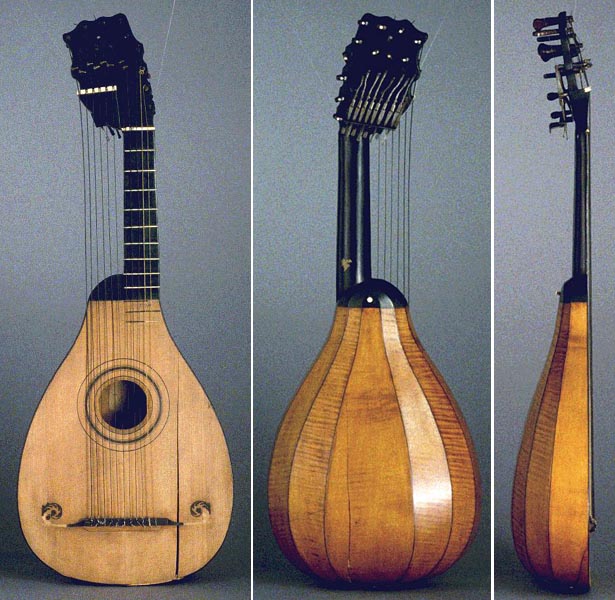
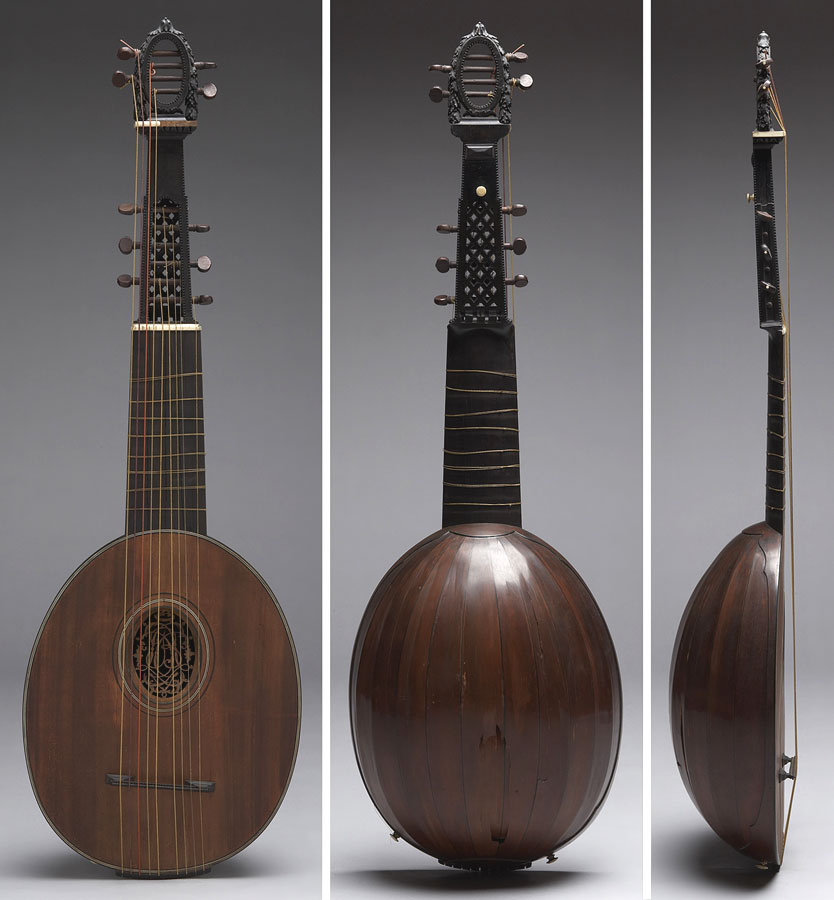
| Naderman (Jean-Henri) bissex, Paris, 1773 | Pacquet (Jean-Baptiste) bissex?, Marseille, 1774 | Thiphanon (Jean-François) bissex, Paris, 1780 | Caron
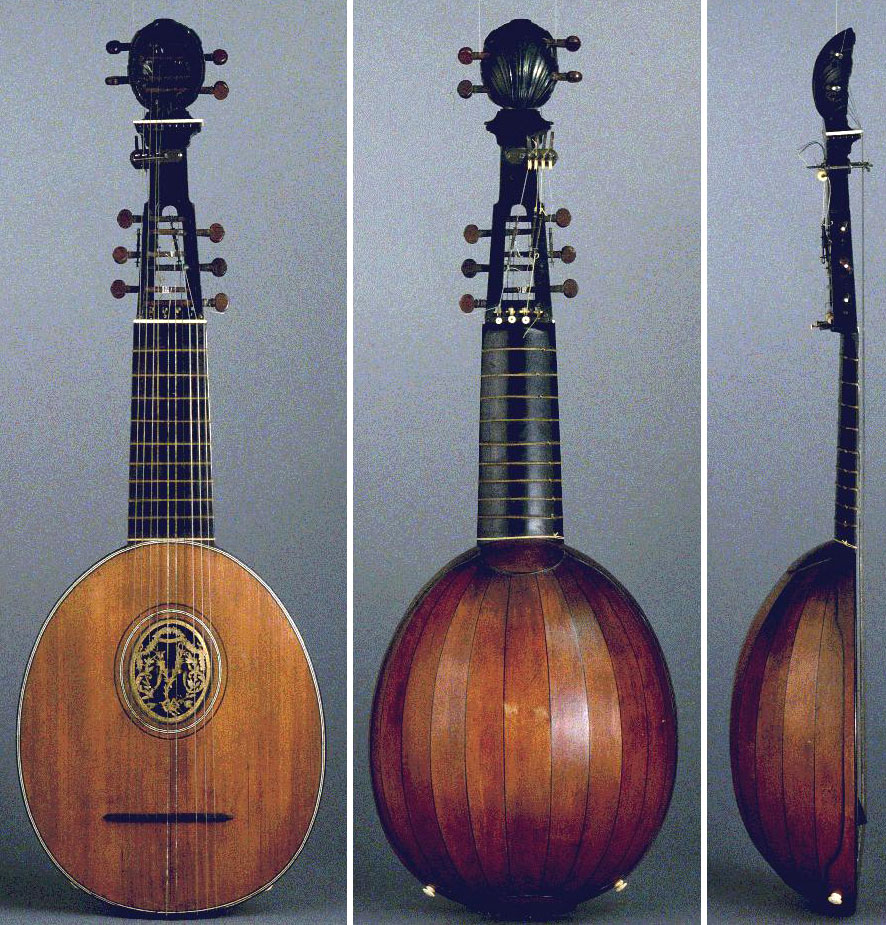
(Jean-François) Guitare decacorde, 1784 © Yale University Collection of Musical Instruments Photo credit: Alex Contreras |
Caron Guitare decacorde, 1785 |
|
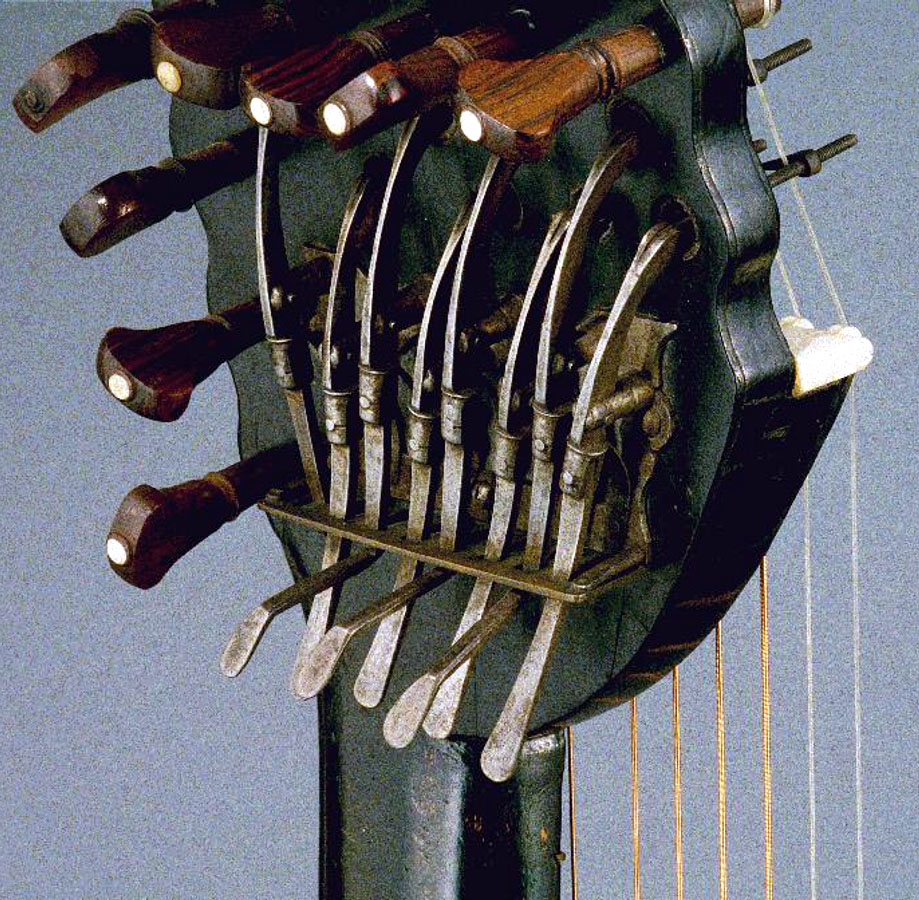
According to Dictionnaire des Facteurs de Guitare Français by Marlat & Hofmann (2025), Belgian musician Vanhecke claimed to have invented the bissex, "a guitar with two rows of six single strings each." However, despite its name ("twice six"),and its two distinct nuts carrying six strings each, along with what has been previously been written (Baines, et al) - the tuning is not 6 standard neck strings and 6 descending basses. According to Marlat & Hofmann, only the first four strings on the neck "form the range of the simple guitar" (the remaining strings being played open), while according to Joscelyn Godwin (1974) the tuning was possibly the then-standard five string tuning (down to A), then the first sub-bass G still on the same neck, continuing on to the second neck with F-E-D-C-B-A. The latter would then be much the same principle as Carulli's decacorde (several decades later) that descended to C. To clarify, while strung as (6+6), the bissex is tuned either 8+4 or 7+5 (where Carulli's is 5+5). Whatever its tuning, its single strings, as opposed to double courses, apparently appeared earlier than those of standard (5-, then 6-course) guitars of the time. I believe the tuning may have indeed consisted of only the four high strings being fretted and tuned to a guitar, with the sharping levers being our simple clue. While all researchers (including Godwin) point out the sharping levers for the six longer bass strings, the photos clearly show that there are eight levers, one for each of the 7 "extra" strings, plus the 5th string on the neck (the highest string lever appears broken off). The bissex by Thiphanon also has 8 sharping levers. A third possible bissex by the obscure violin maker Pacquet, was hiding in plain site at the Paris museum, alongside its other two. It had been labeled "arpi-guitarre" - but after questioning by myself and Benoit Meulle-Stef (late 2011), they realized it was, in fact, a bissex (the extension is broken off). Note how the bridge, offset neck, body shape and distinctive 7-ribbed semi-flattened bowl are clearly patterned off the Naderman (with the Thiphanon version a seeming cross between these two). (Click for larger images) On each specimen, especially the original invention, the body is more or less lute-shaped, with a staved, lute-style back. There is an interesting Naderman document (discovered by Steve Sedgwick) that appears to show his bissex with flat guitar sides, though this may simply be poor artistic license by someone unfamiliar with the new instrument (a 2nd bissex is behind it). Some researchers consider the bissex to be a guitar, and thus one of the "first harp guitars" and/or the Naderman "the oldest surviving harp guitar." Obviously, I consider it more of a "hybrid instrument" (of lute and guitar). Indeed, Naderman was a harp builder, Thiphanon built theorboes, and Pacquet is well known for his unusual 7-string Arpi-guitare invention. If one does want to consider these bissex "harp guitars," I imagine they must also consider most every instrument on this page to also be "harp guitars." |
The slightly later French 10-string instrument by Caron is more of a mystery. Note how the gut strings of his invention attach to the tail block. Two similar specimens are known, with the right one (Paris) showing a fascinating string sharping system for the 4 sub-basses. The tuning is not known. Again, if the name is accurate, one is tempted to theorize standard guitar tuning for the 6 neck strings (which was not unknown, but still rare, in 1785). Godwin postulates a tuning which would appear in a similar, but much later, 1848 instrument, with the known tuning of G A Bb C / d f a c' e' g'. This is certainly likely, as it resembles that of the French arch-cittern of the same general time frame. Regardless of tuning, the form alone seems to make it more of a hybrid invention, like the bissex. |
|||
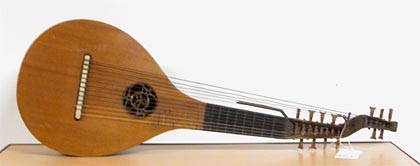
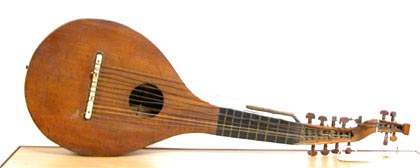
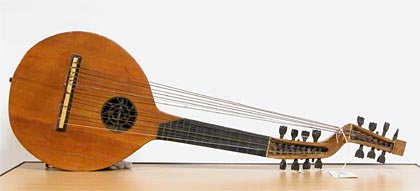
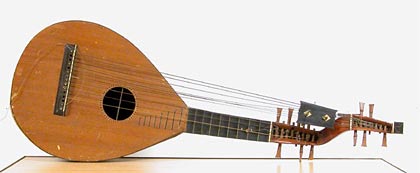
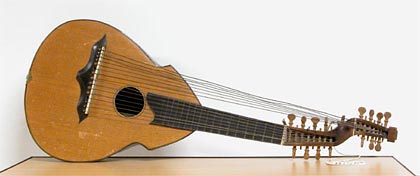
| Swedish This first group of instruments include what I classify as "true Swedish lutes." Following below are what I term "false Swedish lutes." While many scholars are aware of and discuss the differences, many lump the two indiscriminately together, as do some modern makers who reproduce both instruments. The true Swedish lute is a12 to 15-course instrument strung in gut, with 8 strings on the neck (sometimes doubling the 3 high strings) and 4, 5 or 7 open bass strings. The tuning, developed from the English guittar, was an "open" chord on top with descending basses, much like the Light harp-lutes. Note that I therefore do not include these makers in the Encyclopedia, but that I do include makers of "false Swedish lutes," which share the harp guitar's configuration, tuning and playing technique (and were often made and marketed side by side by various shops). This group of exquisite, rare photos comes from the Stockholm Music Museum. |
 |
 |
 |
 |
| Kraft, Mathias Petter, Stockholm, Sweden | |||
| 177x (8+4, 3 neck strings doubled) | 1790 (8+5) | 1792 (8+4) | 1794 (8+7) |
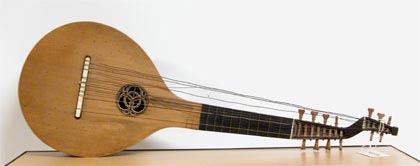 |
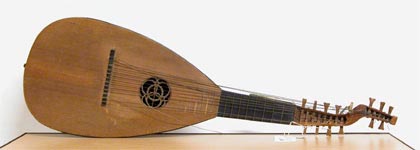 |
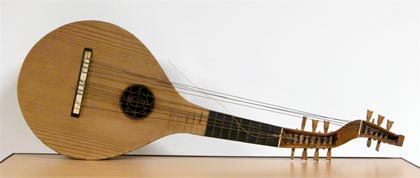 |
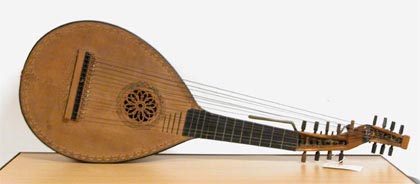 |
| Johan Jerner, Stockholm, Sweden | |||
| 1791 (8+5) | 1792 (8+5) | 1797 (8+7 | 1808 (8+7) |
 |
 |
 |
 |
| Anders Odendahl, Stockholm?, Sweden, 1812 (8+7) |
Erik Ryberg,
Uddevalla, Sweden, 181[1?] (8+7) |
Lorens
Mollenberg, Stockholm, Sweden, 1815 (8+7) |
Unknown, Stockholm?,
Sweden, 1800s (8+7) |
|
German,
Swedish,
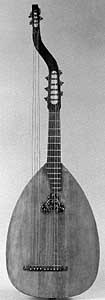
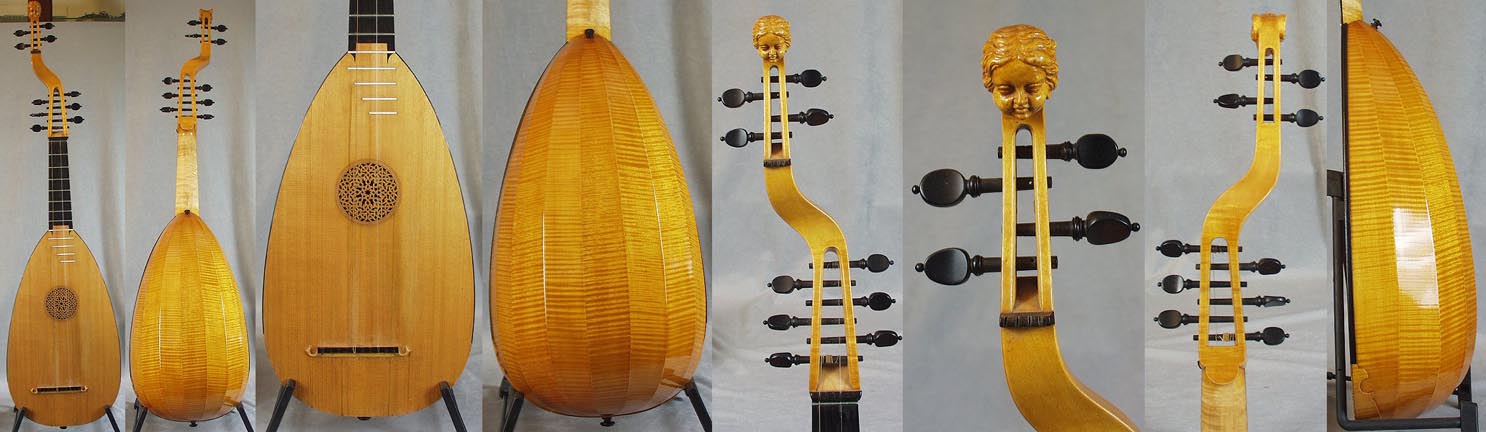
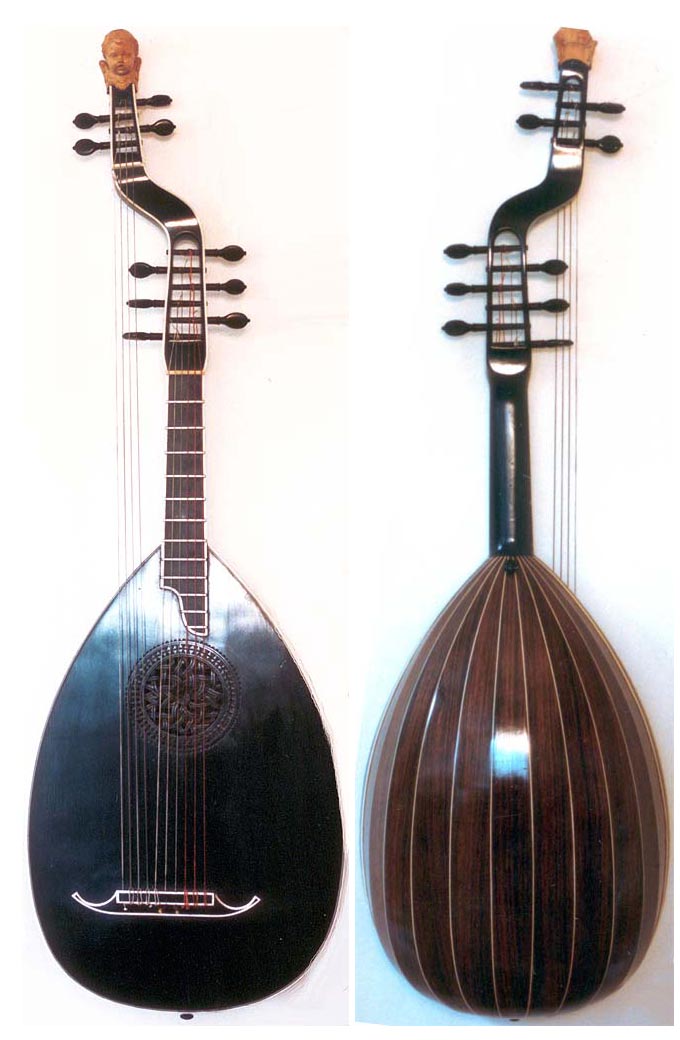
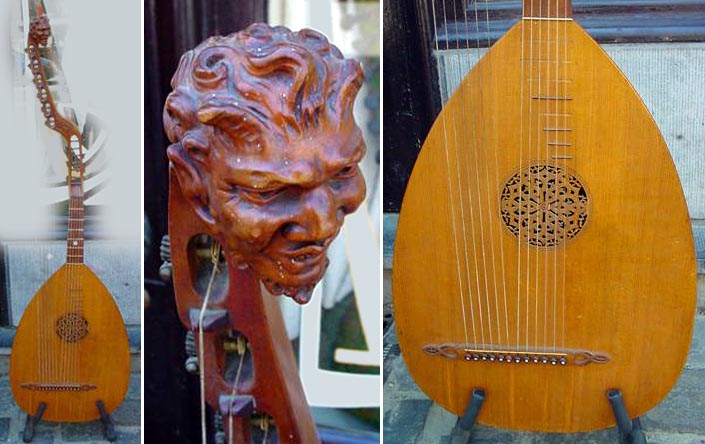
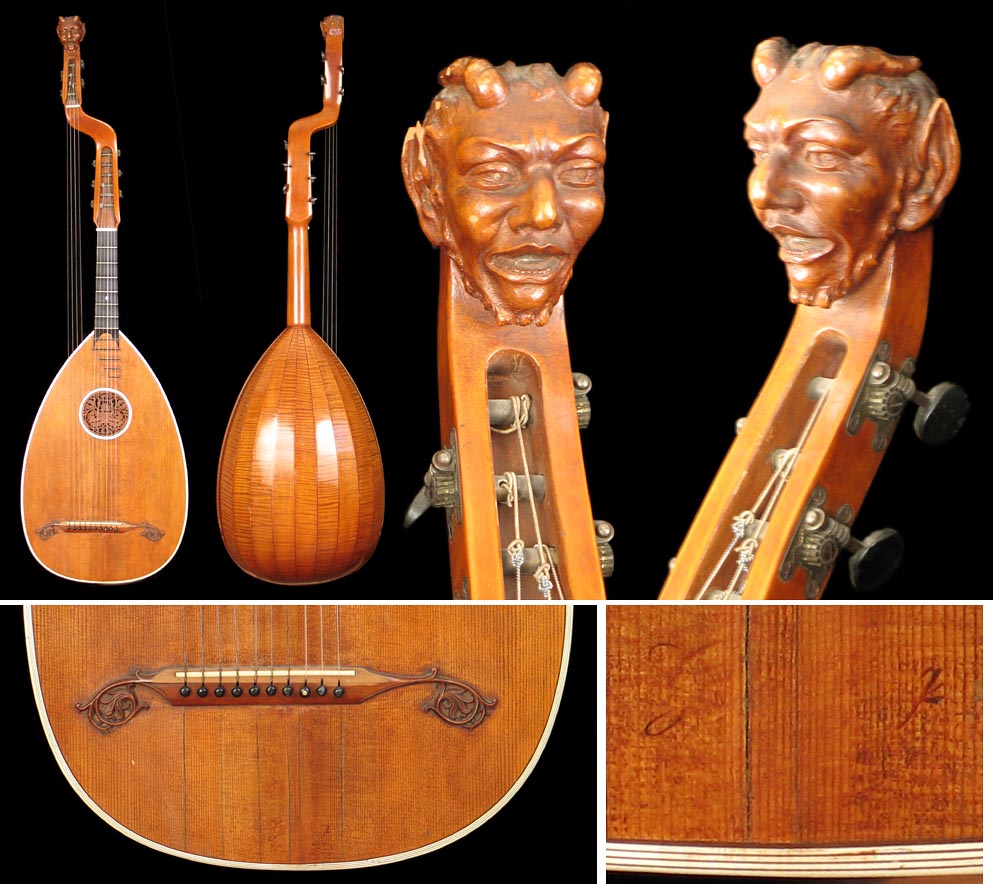
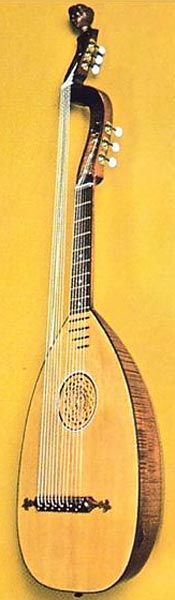
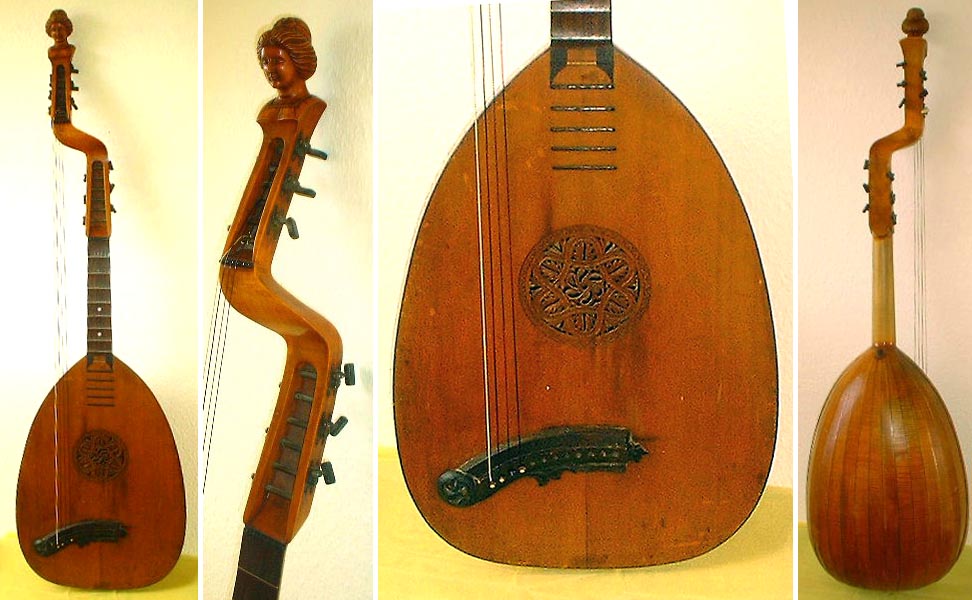
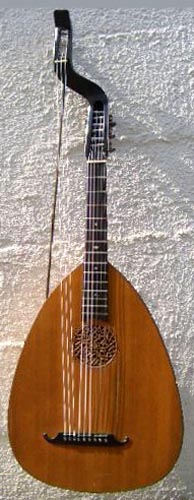
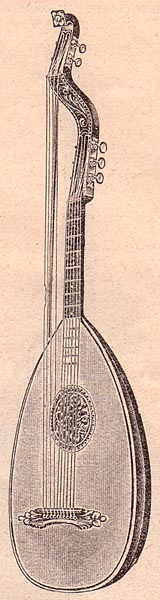
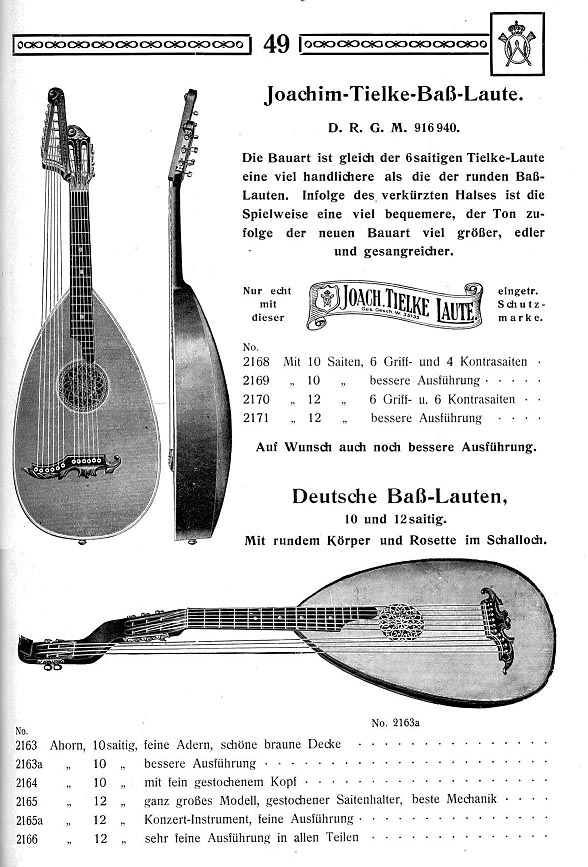
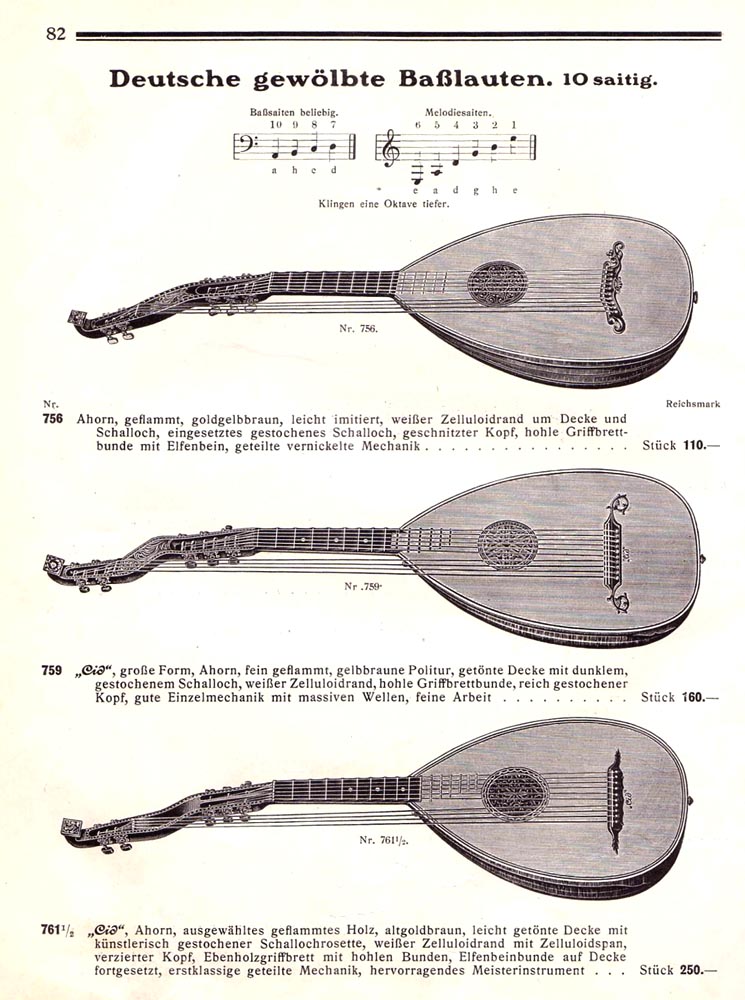
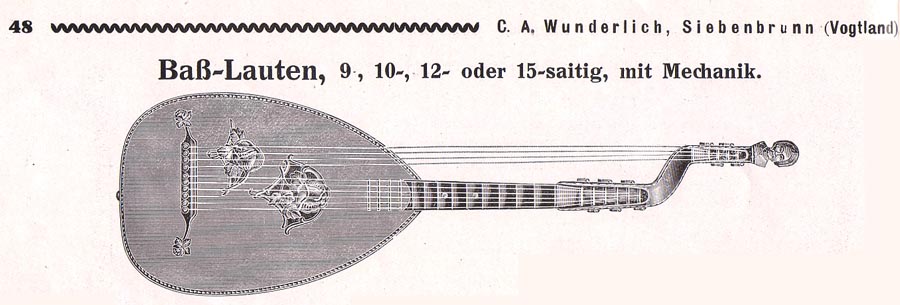
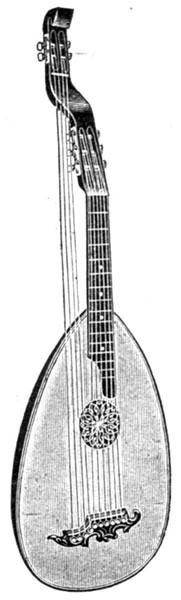
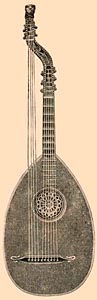
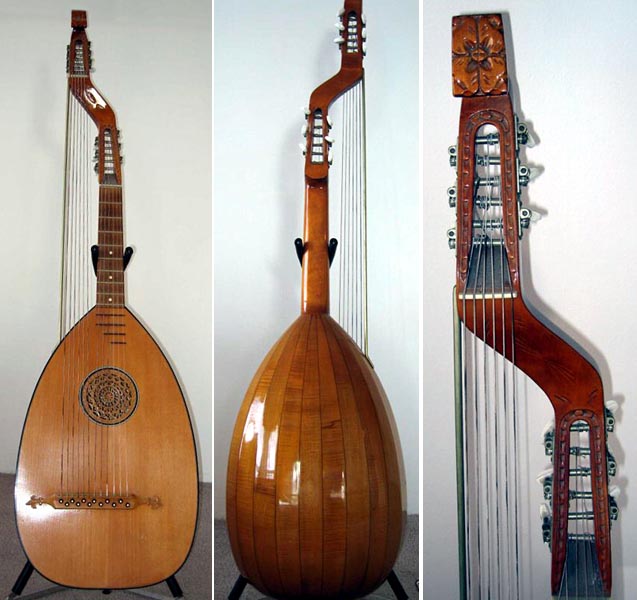
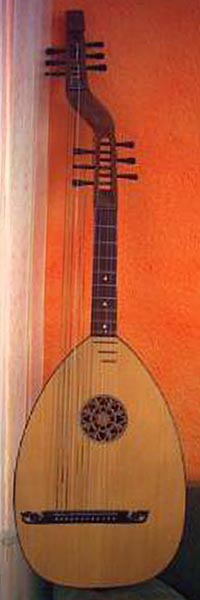
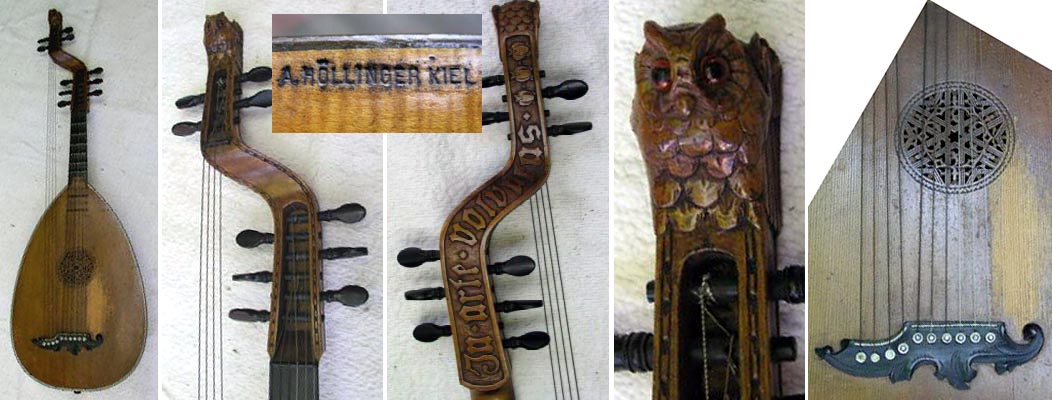
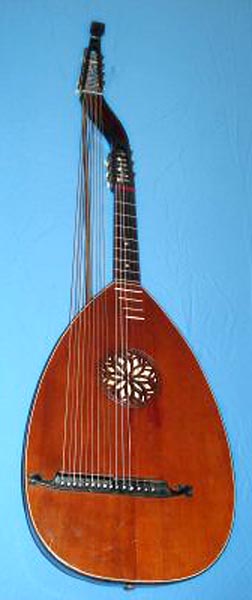
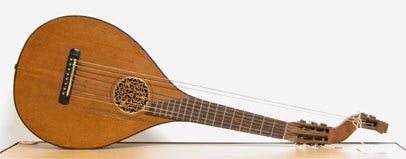
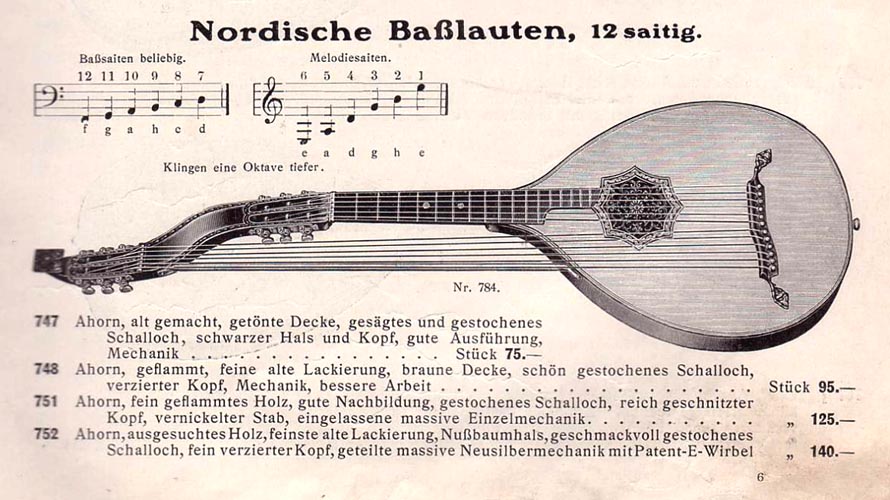
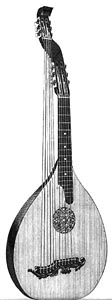
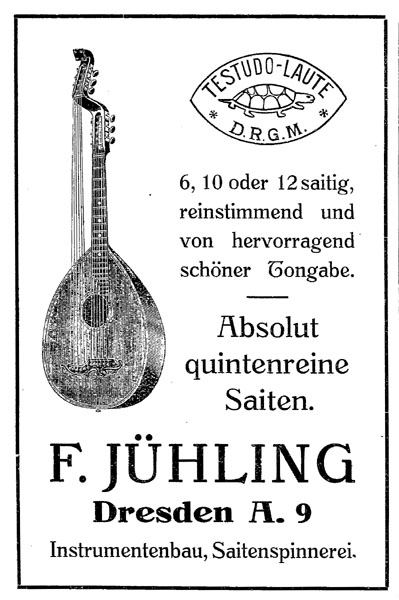
Danish Here are the endless varieties of what I classify as either "theorboed lute-guitars" or "false Swedish lutes" - depending (generally) on the body shape (regardless of country of origin). Originally, the former were (and still are) called Bass-Lauten ("bass-lutes")(Germany), while the latter were/are known as Nordische Basslauten (Nordic bass-lutes)(Germany) or Swedish lutes or Scholander-lutes (Sweden: named after its most famous player [see Iconography: Harp Guitar Relatives]). As stated above, the "true" Swedish lute from a century earlier (above) was a somewhat different instrument (see Organology Part I). Instruments in this first group are basically all similar theorboed versions of the "lute-guitars" that were very common from 1890-1920. They are as close to a true harp guitar as one can get, and were played by guitar players exactly like harp guitars. All have a standard 6-string guitar neck and generally 4 or 6 sub-basses. The body is of standard lute shape. Not just a wandering minstrel's "folk" instrument, many were built by the finest guitar makers and played by well-known guitarists. UPDATE, April, 2014: Originally, I referred to these instruments throughout the site as (theorboed) "guitar-lutes," the term I had seen used predominately by English-speaking authors. Some time ago, I realized this was sloppy terminology which went against the proper classification semantics I have been slowly trying to re-write (for many different musical instrument forms). Thus I scoured my entire site, changing each entry to the more proper "lute-guitar" (the first term being the "descriptor," the second being the prominent basal instrument). |
 |
 |
 |
 |
 |
 |
 |
| Adolf Paulus, 1924 | Hermann Hauser, Munich 1924 | Hermann Hauser, 1931 | Heinrich Fuchs, 1920s | Halbmeyer, 1904 | Halbmeyer,
Munich, 1909 (spelled Halbmaier on label) |
J. H. Zimmerman, Liepzig, 1900s |
 |
|
 |
 |
 |
| Gotz (or Goetz?) | Paul Kochendörfer, 1923 | Sinfonia, Markneukirchen | Goldklang | M. Zimmer, Nuremberg |
 |
 |
 |
 |
 |
 |
| Meinel & Herold | "Otwin" brand, Otto Windisch company | Schuster Brothers (Gebrüder Schuster) Markneukirchen, 1920s | C. A.
Wunderlich, Siebenbrunn (near Markneukirchen) 1938 |
Wilhelm Kruse, Markneukirchen | Heinr. Moritz Schuster, Markneukirchen |
 |
 |
 |
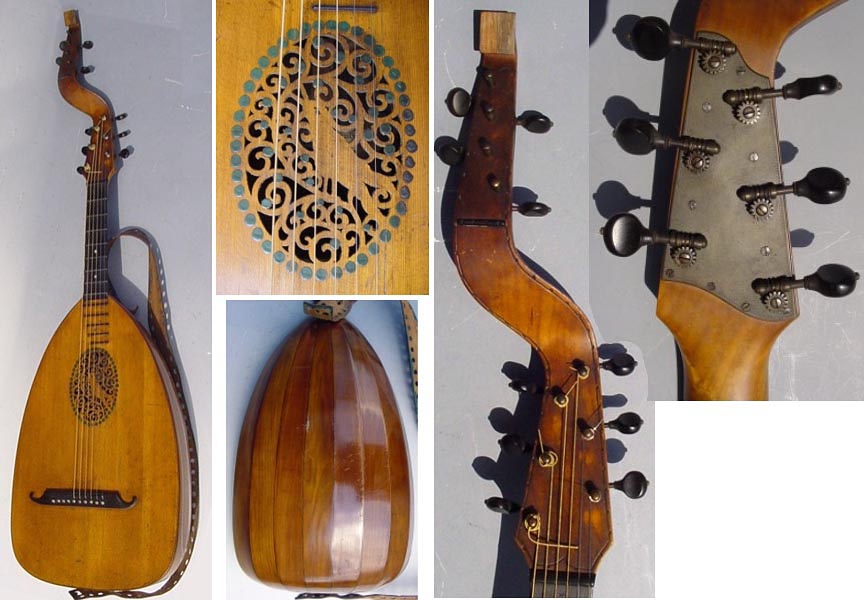 |
 |
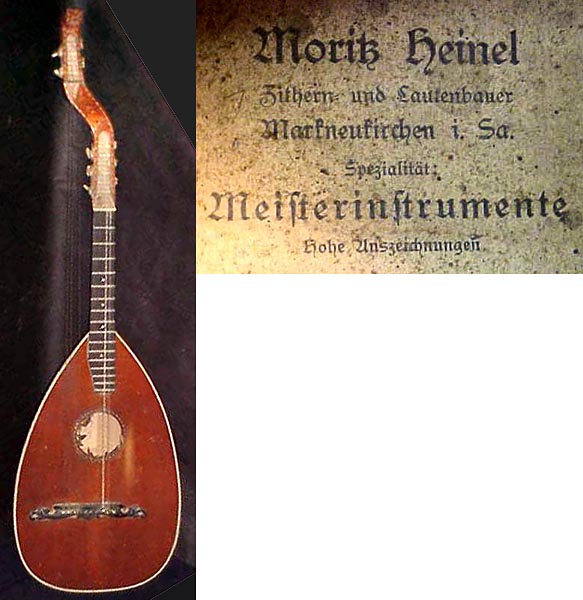 |
| Gunter Penzel, Markneukirchen, new | Steffen Gläsel, Markneukirchen, 1999 | A.
Höllinger, Kiel, Germany |
August Schulz | Otto Tittmann | Morik Heinel, Markneukirchen |
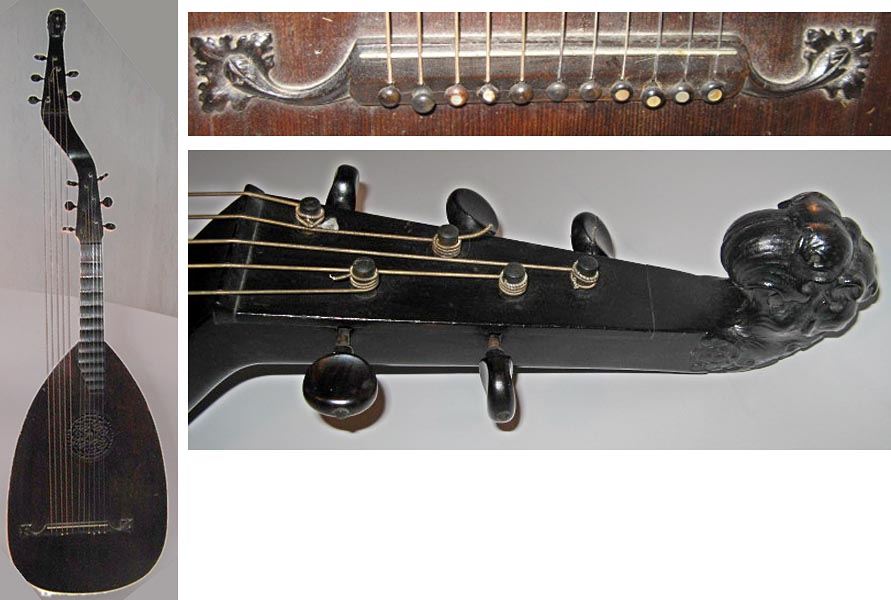 |
 |
|
| Unknown, 5-bass | Unknown, 9-bass | Meinel & Herold, 9-bass |
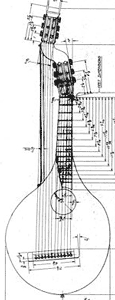
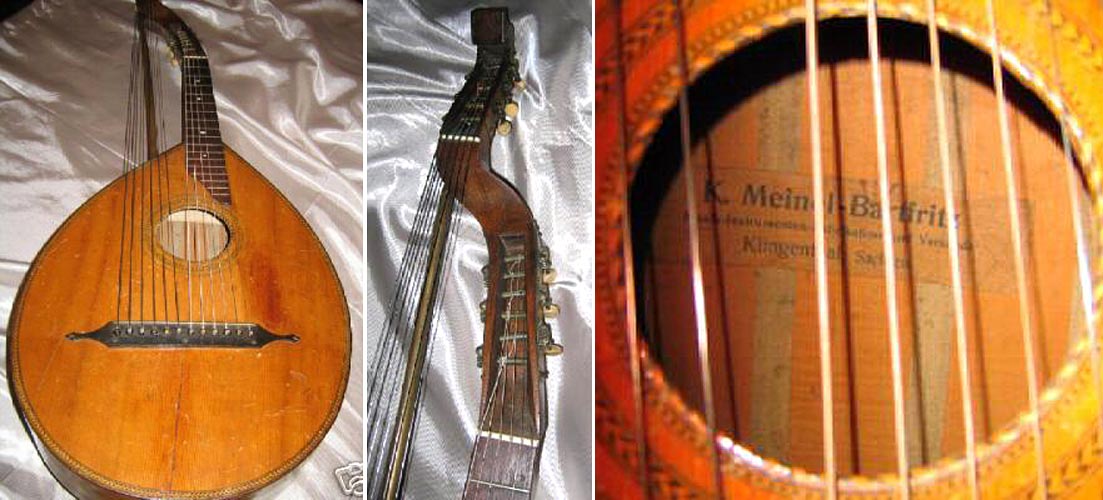
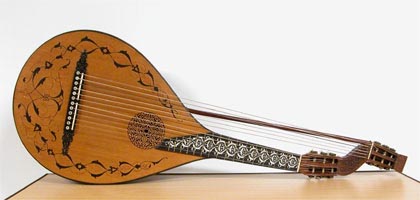
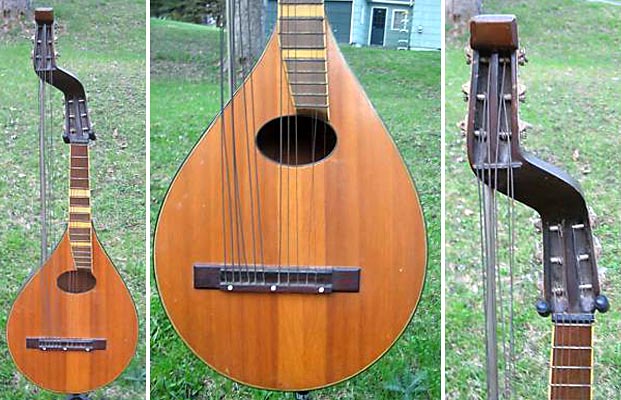
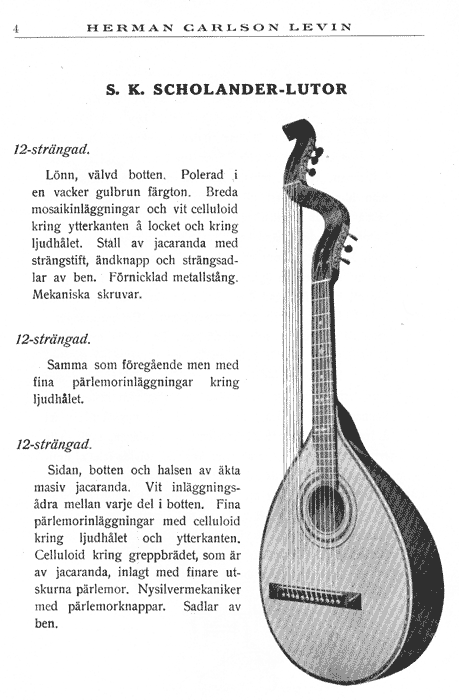
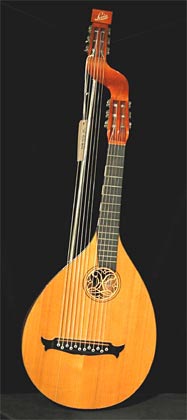
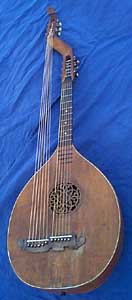
| Instruments in this second group follow the body shape of the "true" Swedish lute. |
 |
 |
 |
 |
 |
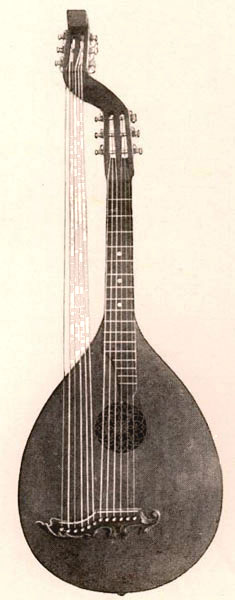
| "Swedish Lute" patent, date? | J. H. Zimmerman, Liepzig, 1900s | K. Meinel-Bartfritz, 1900 | Alfred Brock, Stockholm, Sweden, 1910 | Alfred Brock,
Stockholm, Sweden, 1920 (6+2) |
 |
 |
 |
 |
 |
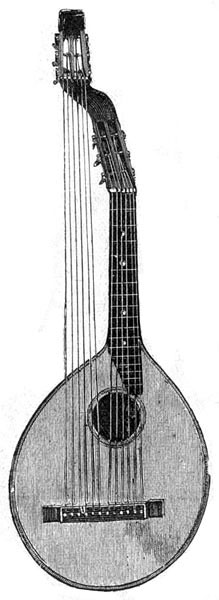 |
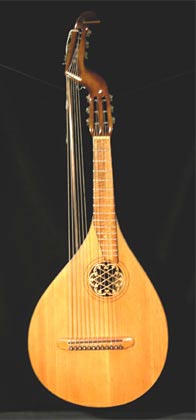
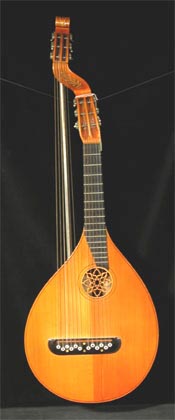
| Paesold, Bohemia, pre-1918 | Schuster Brothers (Gebrüder Schuster) Markneukirchen, 1920s | "Otwin" brand, Otto Windisch company | F. Jühling, Dresden, c.1911 | Neuner & Hornsteiner, Markneukirchen | Voight, Markneukirchen |
 |
 |
 |
| Bo Wretling, Stockholm, Sweden, 1947 | "Crafton" brand, Gothenburg, Sweden, c.1950 | Johann H. Hoffman, Stockholm, Sweden, 1951 |
 |
 |
 |
 |
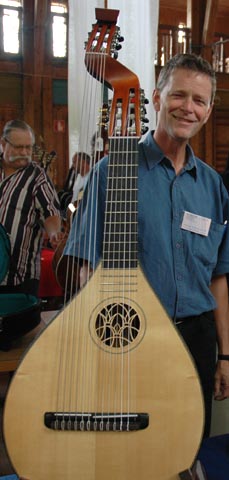 |
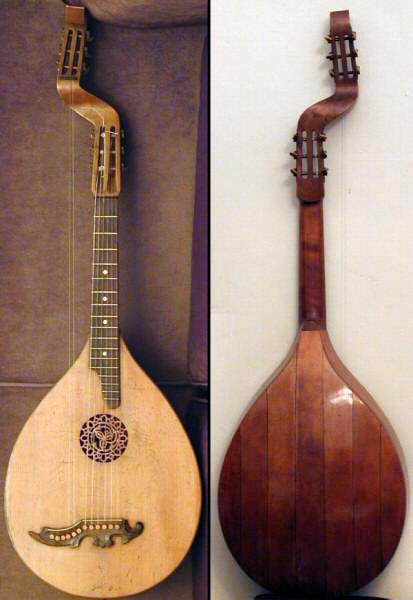
| H. Levin, New York/Gothenburg, 1902 -1923 | Levin, Gothenburg, Sweden, 1952 | Wilhelm Kruse, Markneukirchen | Goldklang | Sällskapet Svenska Lutan. 2005 |
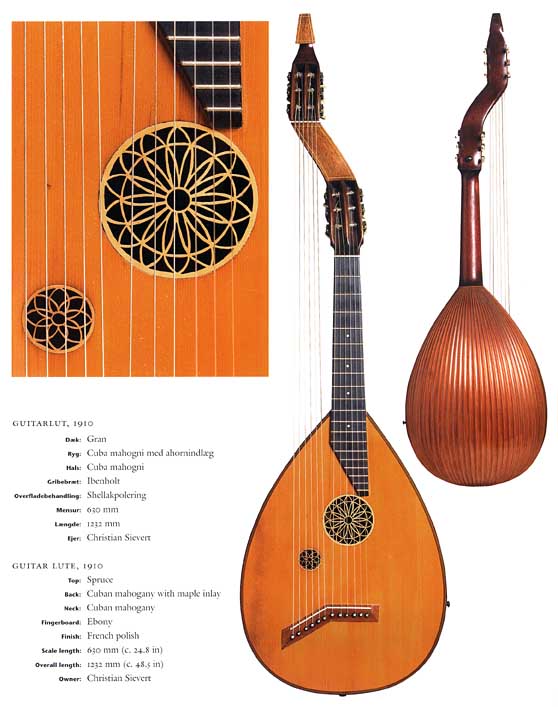
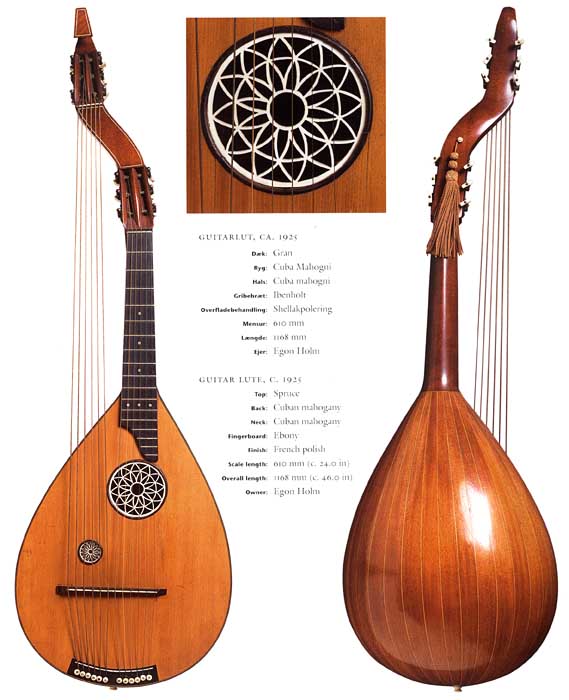
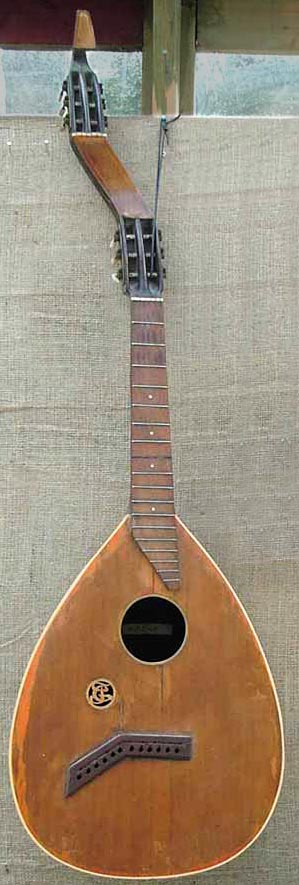
| This third group consists of Danish theorboed
lute-guitars,
which closely follow the Swedish lute shape. Note the similarity and consistency of style
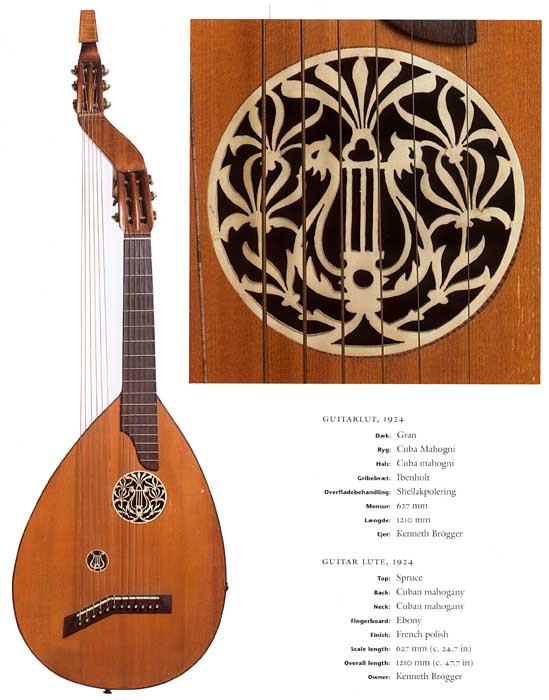
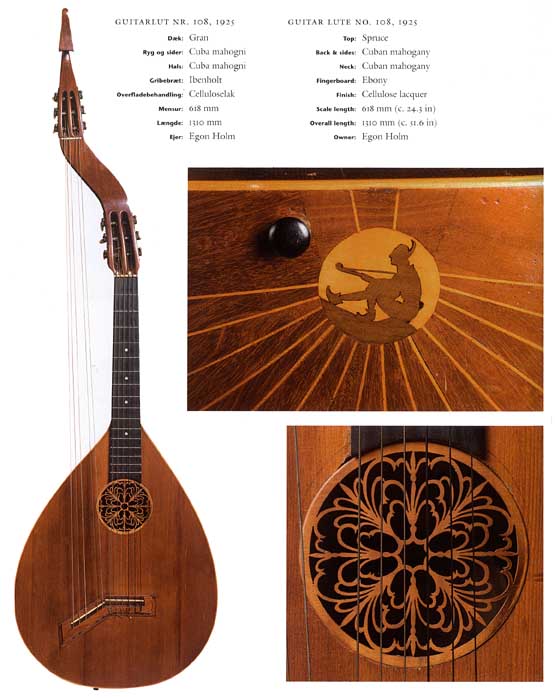
of these first five Copenhagen makers. The first 4 images are from the book Danish Guitars and Their Makers by Kenneth Brogger. |
 |
 |
 |
 |
 |
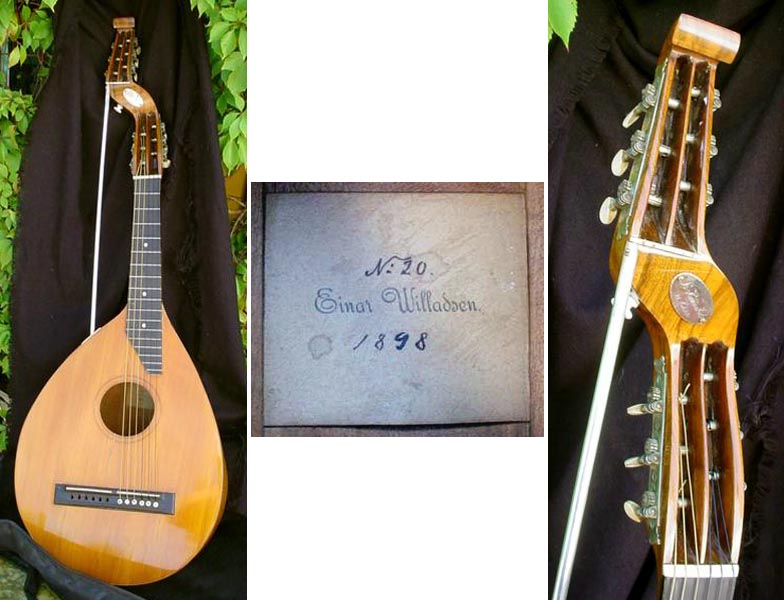 |
| Peder Stochholm, c.1910 | Thorvald Lund, c.1925 | Thorvald Lund, 1924 | Johannes Moller, 1925 | J.R. Rieche | Einar Willadsen, Copenhagen, 1898 |
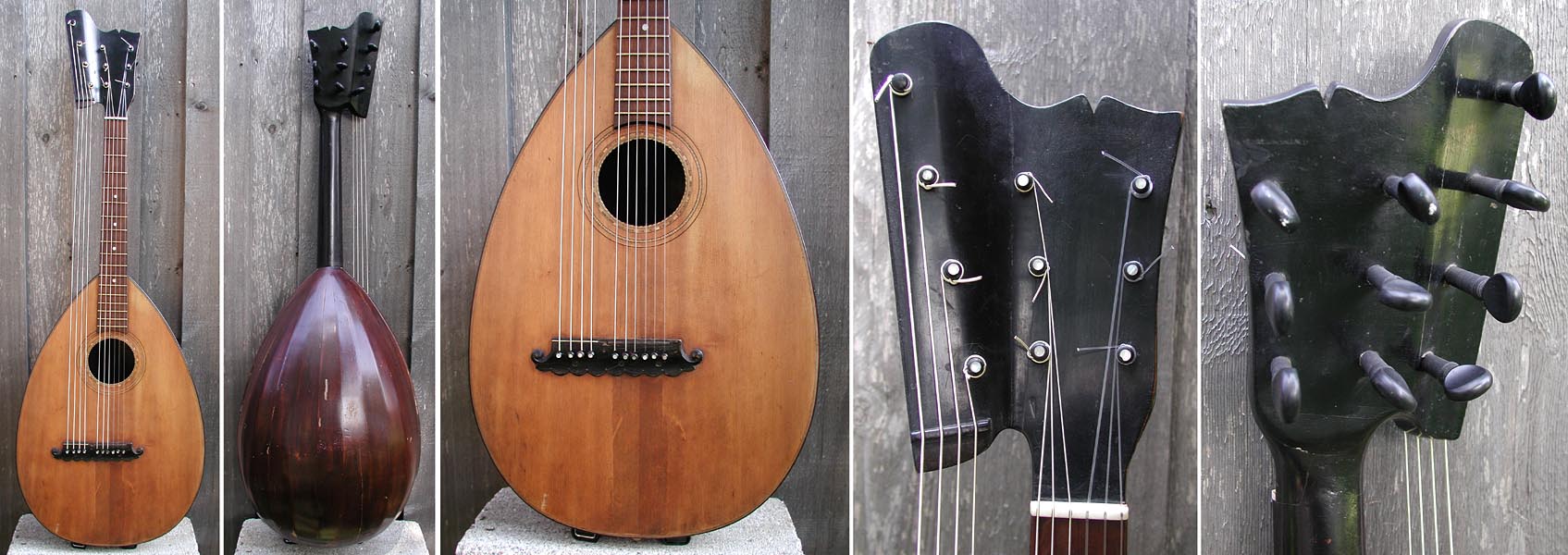
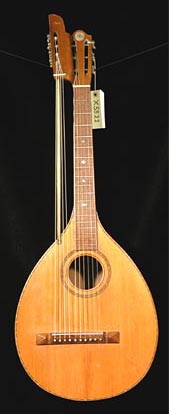
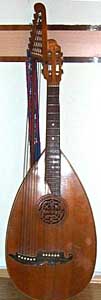
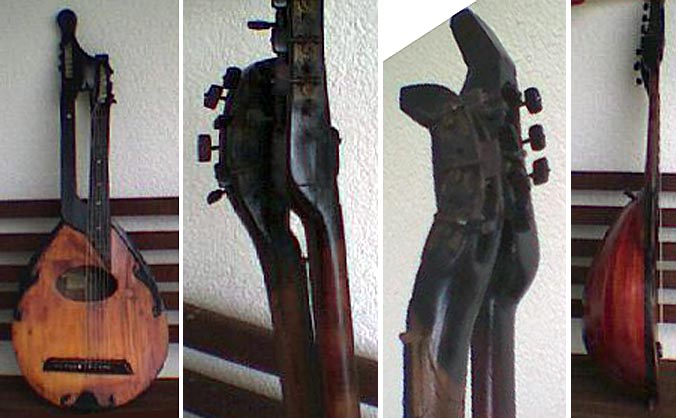
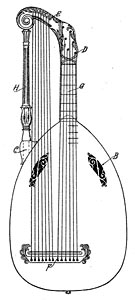
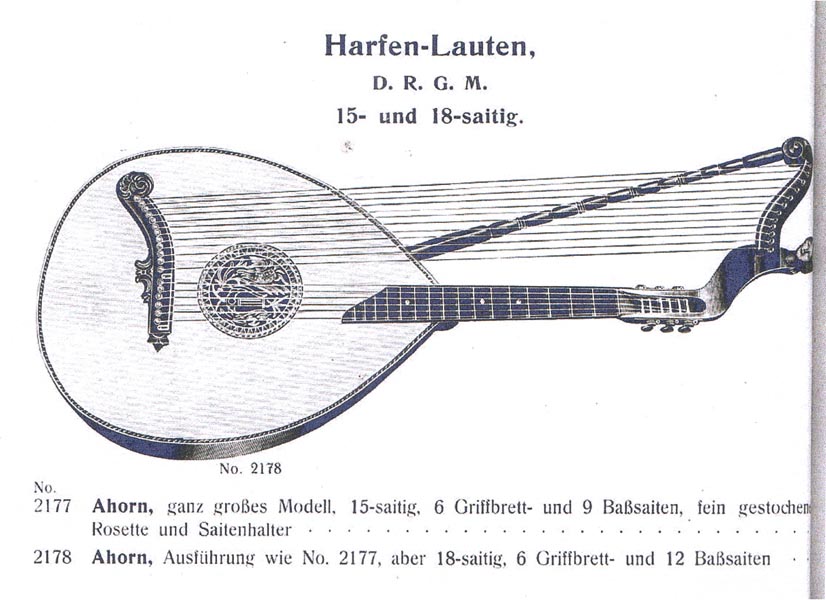
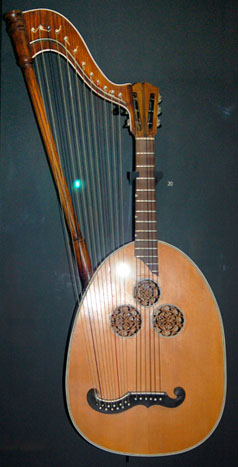
| These strange theorboed lute-guitars have bass extensions used on harp guitars, rather than the typical "bass-lute" configuration. |
 |
 |
 |
|
| Unknown
The pear shape, lute back and bridge belong to the lute-guitar family. The headstocks, tuners and soundhole are pure harp guitar! |
Herman Carlson Levin, 1927, Gothenburg, Sweden | J. Tielke | Patented Joachim Tielke Bass-laute, distributed by Otto Windisch company |
 |
 |
 |
 |
 |
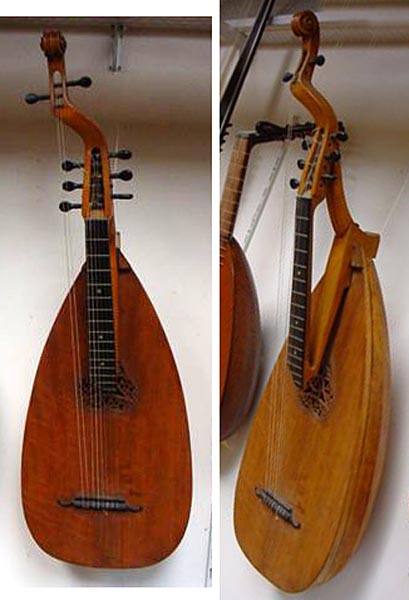
| Unknown
This strange instrument appears to be a German lute-guitar combined with the floating fingerboard concept of Pacquet's 1784 arpi-guitare - with a theorboed headstock for two sub-basses yet! |
Unknown
In the expanded image, one can see the lute back of this very strange double-neck instrument. The headstocks and tuners also beggar description. |
"Harfenlaute" patent, Johann
Lührs Rüstringen, Oldenburg Nov 6, 1920 Patent # 346,447 |
"Harfen-Lauten" ("Harp-Lute")
distributed by the Otto Windisch
Company (Available with either 9 or 12 basses!) Was this instrument based on the previous patent?
|
Unknown (Musikmuseum, Basel Switzerland) |
Russian
 |
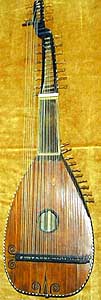 |
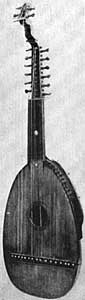
| torban, 19th century | torban |
Ukraine
 |
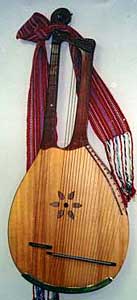 |
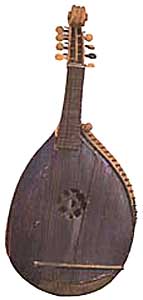
| kobza-bandura hybrid | kobza-bandura hybrid, 20th century |
|
From
researcher Jurij Fedynskyj |
|
Misc.
 |
 |
|
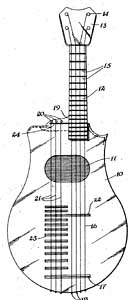
Boothe "sirelin,"
1928, |
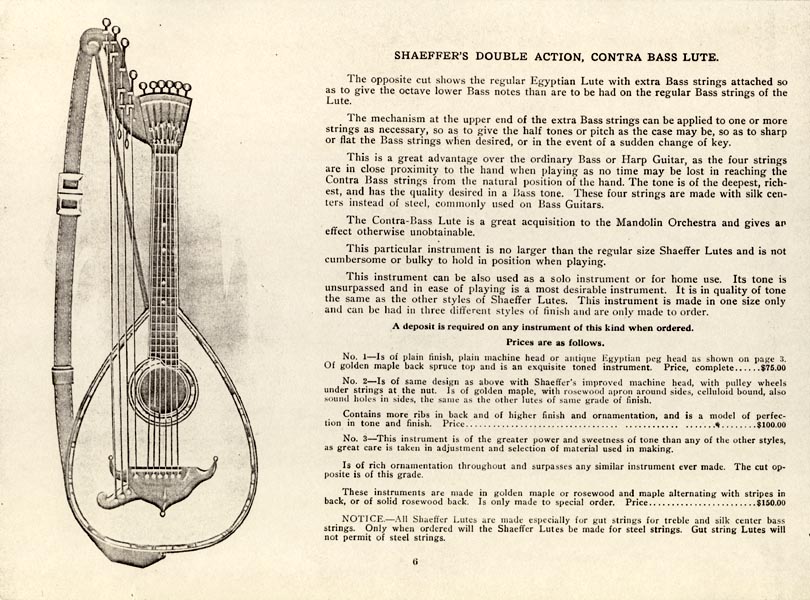
Arling Shaeffer, Chicago, 1912 "Contra Bass Lute" A theorboed version of a strange large-bodied bowl-back gut strung guitar Shaeffer called the "Eqyptian Lute" with his unique tuners. |
|
If you enjoyed this article, or found it
useful for research, please consider making a donation to The
Harp Guitar Foundation,
|
|
|
|
All Site Contents Copyright © Gregg Miner,2004-2025. All Rights Reserved. Copyright and Fair Use of material and use of images: See Copyright and Fair Use policy. |