|
Organology: Harp Guitar "Relatives" Note to the casual reader or researcher: This Reference Gallery features historical instruments that are not harp guitars, but “relatives” or distant “cousins” – presented on Harpguitars.net for historical and organological comparison.
Extended
Range Guitars Not to be confused with harp guitars, these are "extended-range" guitars with extra bass strings beyond the standard guitar's low E string (though some may be tuned higher than this low E), and occasionally extra strings above the guitars high E. In any case, they are:
Note: For instruments where one or more fretted strings are not fingered, see Fretted Harp Guitars. See bottom of page for image copyright information |
 |
 |
 |
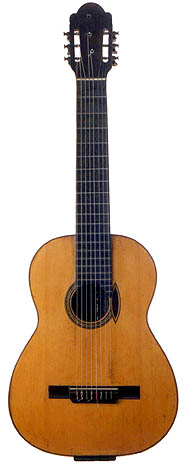
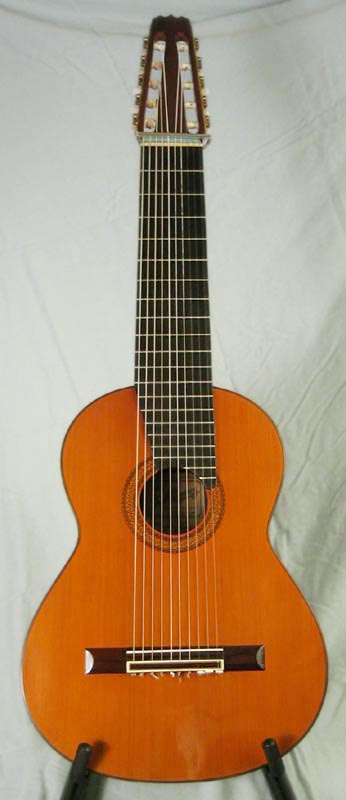
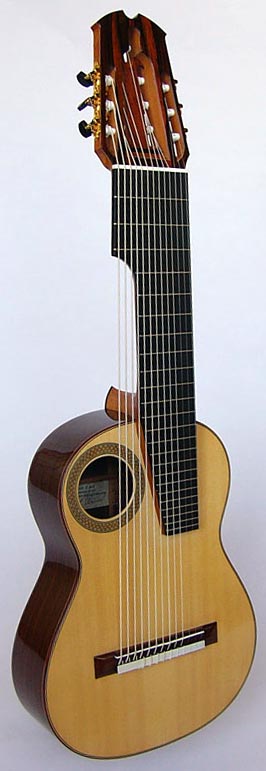
| 8-string guitar, Vicente Arias, 1899 | Ramirez 10-string, 1973 |
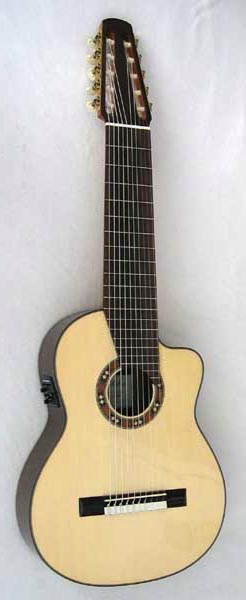
Bartolex (China) 10-string guitar
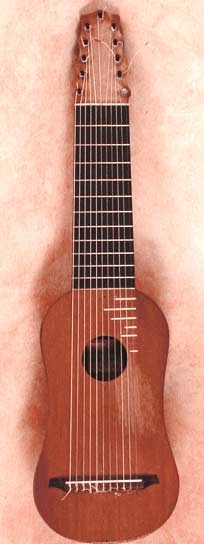
Can be played as either an extended range guitar or fretted harp guitar - and in such cases, be "classified" or called as such. |
 |
 |
 |
 |
|
Peter Blanchette
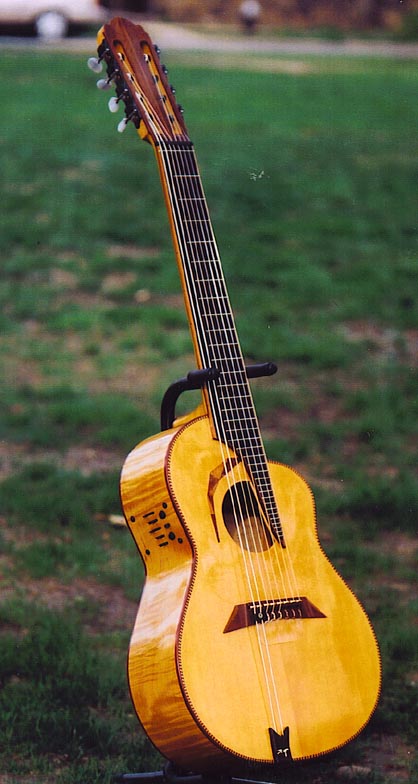
"archguitar" by Walter Stanul, 1981 Some archguitars have been made with floating strings, in which case they are also harp guitars. |
Richard DiCarlo This 8 string was the brainstorm of guitarist Michele Ramo. The range of this instrument is 6 octaves. It is a 34-fret (high D) instrument. The 7th string is low A (.070) and the 8th string is double low D (.080, sometimes .100). The last two strings are played like a fretless bass. Being thus fingered with the left hand instead of played open, this hybrid instrument cannot be considered a harp guitar, but instead, a rare Multi-Course Fretted/Fretless Guitar combo. |
ErmannoChiavi, Zurich, Switzerland
Yes, they look like they are "partially floating," but there are at least 3 frets for every string. Other builders have often provided just one full fret to cover all strings. |
Tonaharp,
c.1916, A 3-tuning (5+5+7) Hawaiian guitar |
|
There are many additional web site sources for
Extended Range Guitars - specifically "10-string guitars"
- but
readers may want to start with these three that perhaps represent
the three main "movements" - each with their own point of
view and specific focus on surprisingly different versions of what
otherwise look like identical instruments. Guitar organology
researchers should be able to easily ascertain the historical and
musical differences between each. www.tenstringguitar.info
(Viktor
Van Niekerk, proponent of the "true" Yepes ten-string guitar) Regarding the recent practice of calling some of these instruments “classical harp guitars” (seen regularly on EBay, for example), it is my understanding that this is for marketing purposes, inspired by Stephen Bright’s choice of terms for his 10-string fretted instrument, which he says he often plays “in the manner of” a harp guitar (by not utilizing the frets for the lowest strings). I have found that many players of various fully-fretted extended-range guitars admit that - in practice - they omit fretting some of their lower strings. These can best be considered - and referred to as - Fretted Harp Guitars (that is, if "harp" must even enter into the discussion at all...). Update: July, 2009: A site visitor named Charles Wood - a 10-string (fretted) guitarist - took the time to carefully read, consider, and then meticulously present his opinions to me about the terminology and definition I previously presented here. Amazingly, we saw each other's point of view and agreed with each other. What Charles was describing was the very real - and very nebulous - "gray area" of the instruments that I had originally addressed on this site under the formal classification "Fretted Harp Guitars." Before too long, I had completely removed that page and term from the site, having decided that the harpolyre (in truth, also a "FHG") deserved its own page, as it is a very specific - and now understood - instrument. I had also feared too much confusion regarding the term "fretted harp guitar" (which does, in fact, sound like an oxymoron!), and frankly, did not want to deal with the endless gray area and minutiae of the many "multi-string guitar" players. So I put my (very clever) "fretted harp guitar" organology into mothballs. But after Mr. Wood illustrated and convinced me that this issue will likely never go away - while at the same time offering clear examples and even new verbiage - I have re-identified the Fretted Harp Guitar here. At the same time, I have tried to carefully rephrase the definition of "multi-course guitar" so that it stands apart from a "fretted harp guitar" (see my Definition at the top of this page). Please note that little of this fits within the realm of harp guitar organology - this whole multi-string mess is simply a necessary evil - as there is much public confusion (and misinformation) about these instruments and how they relate to harp guitars. My harp guitar colleague, John Doan (Professor, Willamette University), who submitted this correction to his 2007 Fingerstyle Magazine article, The Inevitable Harp Guitar, adds this to our discussion: “Gregg Miner and I have spent many a conversation on what constitutes an instrument being an actual harp guitar given that he and I (among others) have tried to organize and encourage players of the instrument through recordings, the internet, and Gatherings. My understanding in a
nutshell: - John Doan, 9/22/2008 |
| John (one of the harp guitar's most knowledgeable and thoughtful scholars) and I agree, as do - judging from my email response and correspondence - the majority of this site's readership. The instruments described here cannot be placed within the "harp guitar" category. Yet, clearly, a specific term and definition are required for the very real conundrum - and increasingly common practice - of a fretted guitar played in the manner of a harp guitar. For clarity and sanity's sake, my proffered term remains Fretted Harp Guitar. |
|
If you enjoyed this article, or found it
useful for research, please consider making a donation to The
Harp Guitar Foundation, |
|
|
|
All Site Contents Copyright © Gregg Miner, 2004, 2005, 2006, 2007, 2008, 2009, 2010, 2011, 2012, 2013,2014. All Rights Reserved. Copyright and Fair Use of material and use of images: See Copyright and Fair Use policy. |